

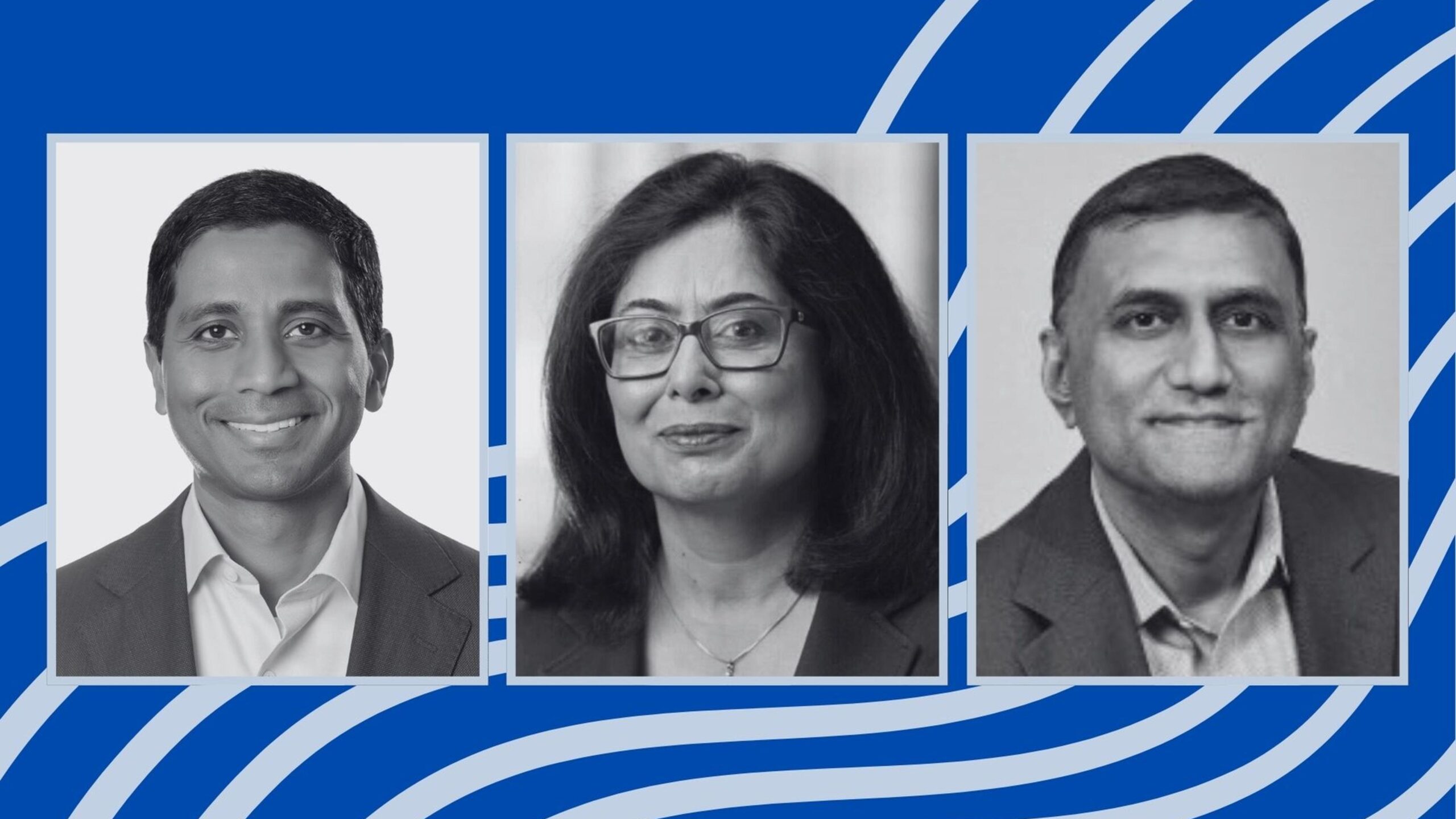
A panel of executives spoke at the TIME100 AI Leadership Forum on Wednesday night in New York City about the ways artificial intelligence is reshaping the business landscape, and how they’re shepherding their companies into a technologically capricious future.
Included on the panel at the TIME forum, which spotlighted AI-driven business leadership, were Nigel Vaz, the chief executive officer of Publicis Sapient, a tech-consulting firm that uses AI to help modernize business and a sponsor of Wednesday’s event; Deepa Soni, the executive vice president and chief information officer of New York Life Insurance Company; and Ravi Radhakrishnan, the executive vice president and chief information officer of American Express.
Vaz began the conversation discussing the “exponential” capability of AI to transform and enhance companies’ abilities to problem solve and become more efficient.
For his company, AI is a tool used to extract value and optimize performance for clients by reducing time and cost. Many of them, he notes, must bridge the gap between their relatively outdated technology and increasingly more useful AI tools––what he referred to as their “tech debt.” The tall task of adopting more efficient tech is weighing down many older companies against new, AI-forward competitors, he says.
But for now, it isn’t obvious to Vaz who’s winning the race to transform the AI industry.
“We have not yet seen the conversation move to ‘What is the Uber and the Airbnb of the AI era?’ in the context of real transformation of industry,” he said. “We’re still focused today on the productivity gains, on the incremental value that we can create, which is perfectly fine, given as we just said, we’re so early in the journey.”
For Soni, AI is a “strategic enabler” within her company. “There are actual business problems that we can solve now with AI that we could not before,” she says, adding that, contrary to popular discourse, AI will not eliminate jobs, she believes, but rather expand the capabilities and services of the workforce.
“I think where we are in the life cycle of adoption of AI, we absolutely think of AI as a human amplifier,” she said. “We are on a growth trajectory, and we can do a lot more with the same workforce.”
At American Express, Radhakrishnan admitted that the company initially didn’t see exactly how AI could best be utilized but that by getting some things wrong, the company figured out other ways to move forward and excel.
“In the early days,” he said, “we had assumptions on where we would see value from the technology, and we quickly learned that sometimes some of those assumptions didn’t work out, but the underlying learnings from the technology turned out to be very useful.”
Despite the rapid progress AI has provided to companies including American Express, and the unpredictable ways in which it will continue to transform businesses and products in years to come, Radhakrishnan believes that company success and consumer opinion will be determined by the same factors by which they are today.
“I think five years from now, after this is played out a bit more, I think we’ll be back to talking about the same things we should always be talking about: trust, service, security,” he says. “It’s consumers who are going to decide on which AI are we going to trust.”
Read the full article here
