

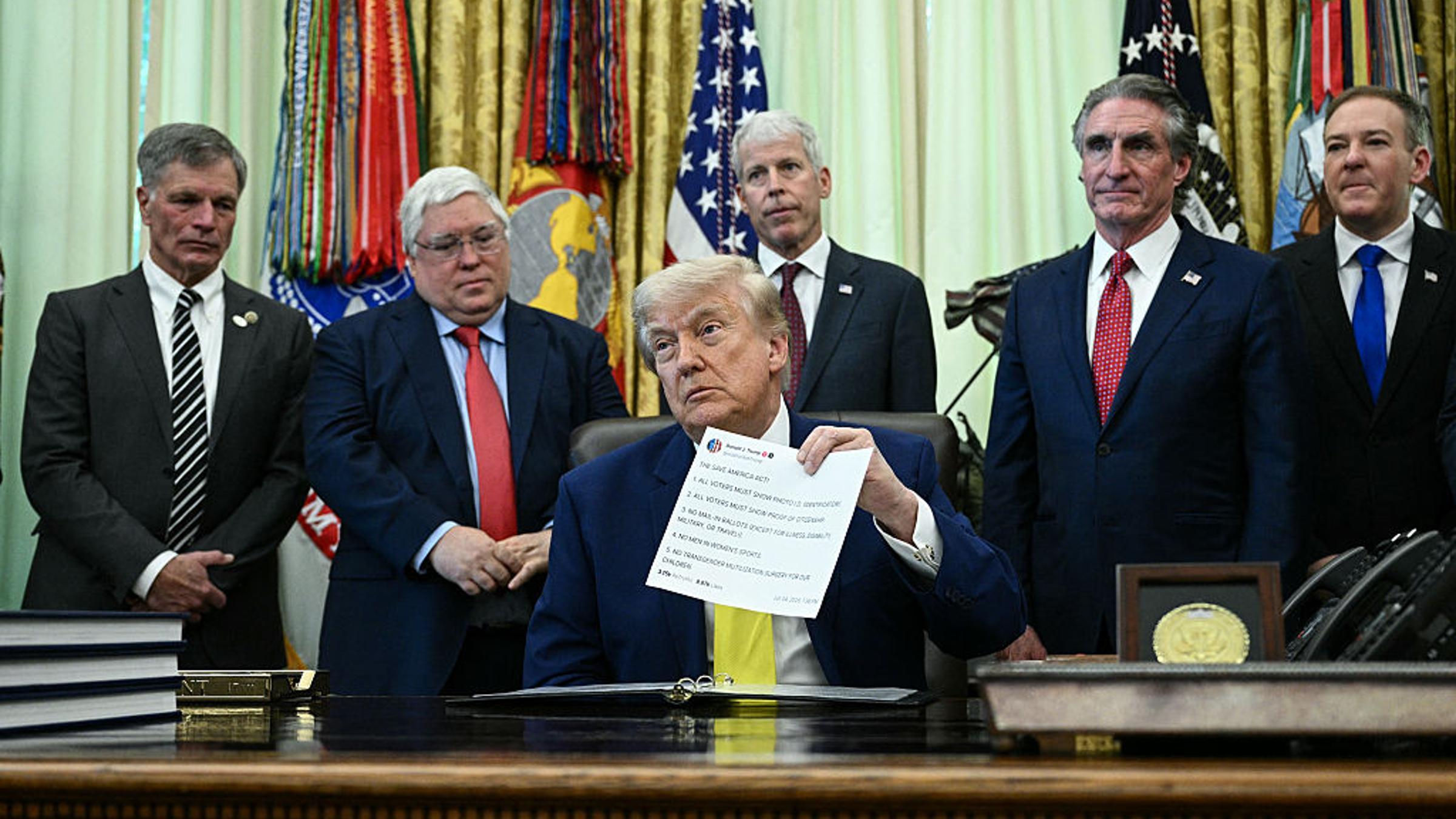
President Donald Trump’s recent refusal to sign a broadly bipartisan housing bill unless Congress first passes the SAVE America Act once again pushed his voting bill back into the center of national politics.
As Republicans—one of us represented Wisconsin in Congress, the other served as governor and attorney general of Pennsylvania—we come from different states with different election systems, but we share the same conviction: only eligible American citizens should vote in American elections, and the public must have confidence that our elections are secure.
That is why we must demystify local election administration and build trust in the people and processes that make our elections work. And it is precisely why we are concerned about the SAVE America Act.
The bill’s central premise is popular: noncitizens should not vote. We agree. However, federal law already prohibits noncitizens from voting in federal elections. Pennsylvania and Wisconsin laws, like those of other states, already require voters to be U.S. citizens. Election officials in both states already use multiple safeguards to verify eligibility, maintain voter rolls, and investigate potential violations.
The real question is not whether noncitizens should vote. The question is whether this federal bill solves a real election-administration problem in a careful, workable way—or whether it creates new problems for millions of eligible citizens and the local officials who run our elections.
This is where the SAVE America Act falls short.
The legislation would require documentary proof of citizenship to register to vote in federal elections, along with photo identification to vote. In practice, that means a standard driver’s license would often not be enough. A REAL ID may not be enough either, unless it indicates citizenship. Voters would generally need a passport, passport card, birth certificate paired with photo identification, naturalization papers, or another qualifying document.
That sounds straightforward—until one considers how Americans actually live.
A young voter registering for the first time may not have a passport. A married woman whose legal name no longer matches her birth certificate may need to produce additional documentation. A rural voter may have to travel a long distance to an election office. A low-income worker may struggle to take time off during business hours. A service member stationed away from home may face barriers that civilians never encounter. A citizen who has voted for decades may suddenly need to produce paperwork simply because they moved, changed names, or updated their registration.
These are not theoretical concerns. They are ordinary facts of everyday American life.
Wisconsin already has one of the more stringent voter ID systems in the country. Voters must present an acceptable photo ID when voting, and voters registering in Wisconsin must provide proof of residence. The state’s system is administered locally by municipal clerks who know their communities and are accountable under state law.
Pennsylvania takes a different approach, but it, too, has safeguards. To register in Pennsylvania, a person must be a U.S. citizen, a resident of the commonwealth, and at least 18-years-old by Election Day. The state’s automatic voter registration system at PennDOT is designed so that only applicants whose records document eligibility are presented with voter registration screens, and county election officials review applications before registration is finalized.
Plus, there is another key concern that Republicans should not dismiss. Our Constitution leaves election administration largely to the states, within a framework set by federal law. Wisconsin and Pennsylvania do not run elections the same way. Nor do Arizona, Georgia, Michigan or North Carolina. That diversity is not a defect. It allows states to build systems suited to their laws, populations and traditions while still meeting national constitutional standards. It is crucial that Republicans stand up for states’ rights—including now.
In Pennsylvania, a divided government has not prevented election reform. Harrisburg currently has a Democratic House and a Republican Senate, and the legislature has passed bipartisan changes to the election code after extensive input from county governments. That is how election policy should be improved: through state-level experience, local feedback and practical reforms shaped by the officials who actually administer elections.
A rushed federal overhaul would impose one blunt solution on thousands of local jurisdictions. It would also ask election officials—already strained by turnover, threats and public mistrust—to implement complicated new requirements. That is not a recipe for confidence. It is a recipe for confusion.
We understand why many voters worry about election integrity. Through our work with the nonpartisan civic education organization Keep Our Republic in battleground communities, we have heard real skepticism and frustration from citizens, election officials, lawyers and local leaders. Those concerns should be taken seriously. But taking voters seriously does not mean endorsing every bill labeled “election integrity.” Some proposals strengthen trust. Others create confusion, burden eligible voters and weaken the state-based systems that already protect our elections.
Real election integrity requires accuracy. It requires transparency. It requires telling voters what is true even when the truth is less politically useful than the fear.
Noncitizen voting is illegal. When it happens, it is investigated and punished. States should continue strengthening their safeguards. But the evidence does not support the claim that noncitizen voting is occurring at a scale that justifies burdening millions of eligible Americans or overriding state election systems with a sweeping federal mandate.
We believe Republicans can be the party of secure elections, limited federal power, competent administration, and personal responsibility. The SAVE America Act, as written, does not live up to those principles. The American people deserve election laws that make it easy to vote and hard to cheat.
Election confidence is built by facts, transparency, and trustworthy administration—not by panic, paperwork, and political ultimatums.
Read the full article here
