

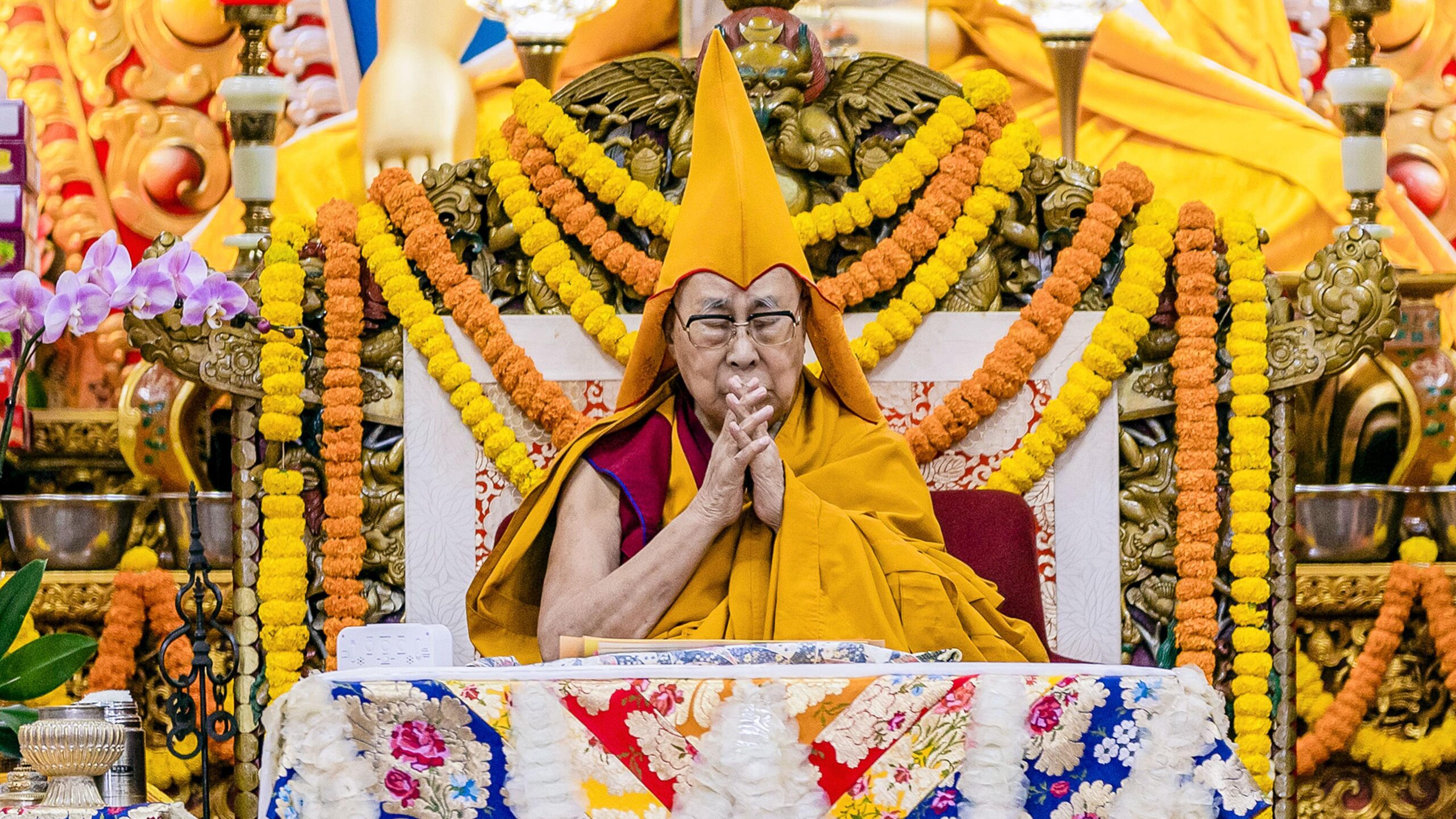
“My No. 1 commitment is to try to promote awareness about our inner value, not based on religion,” His Holiness told TIME in 2019. “How to bring inner peace, how to tackle our anger, fear, through training of our mind.
The paradox of Tibetan Buddhism is this blending of secular wisdom and mystical rite. Several times each year, His Holiness requests guidance from Kuten La, who in his role as State Oracle serves as mouthpiece for Nechung, an ancient deity and Tibet’s spiritual protector. The air inside his temple in Dharamshala thickens with the sharp, medicinal sting of burning juniper and the low, rhythmic thrum of drums and horns. In the center sits Kuten La, whom attendants drape with 80 pounds of ceremonial armor, before crowning him with a towering headdress of gold and mirrors, and securing a silk cord tightly around his throat.
Kuten La’s limbs twitch. His breathing shifts to an unnatural cadence. The physical strain is immense—his face flushes crimson under the regalia—but his consciousness is no longer entirely his own. As he passes the delicate threshold into the trance state, the oracle begins to dance with an otherworldly vigor. He hisses commands, bends iron swords with bare hands, and speaks in a high-pitched, archaic dialect: cryptic divinations sent to aid Tibet’s people and those who lead them. “When Nechung enters me it’s just a feeling of equanimity,” Kuten La says. “But when he’s gone, there’s a bit of discomfort in my heart, or maybe my muscles and joints.”
Read the full article here
