

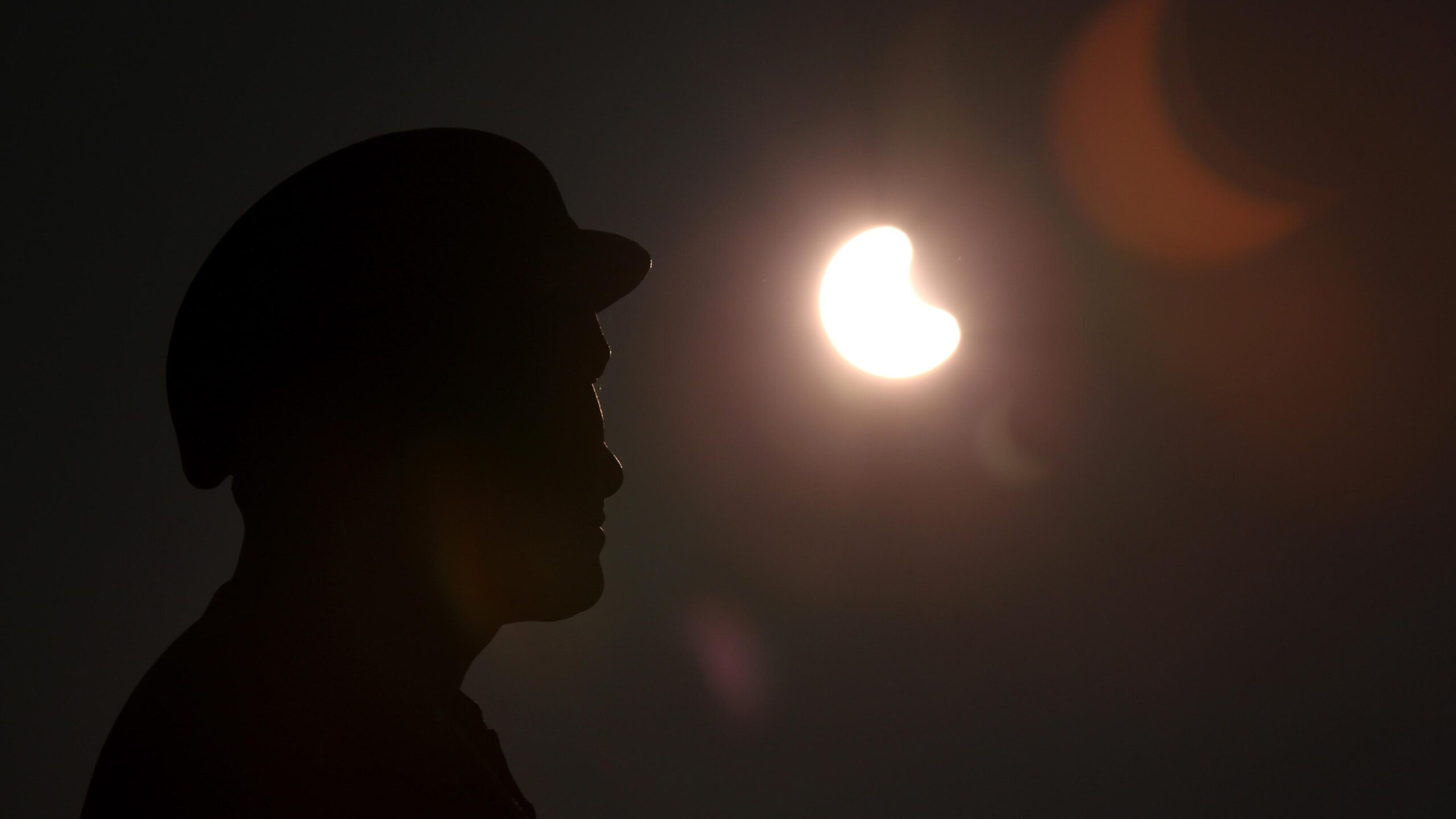
“The moon is always moving, the Earth is always moving, so there’s never a long period of time where the two are able to cross paths exactly, but periodically it does happen, and that’s why you end up with this eclipse,” says Muller.
Earth is ideally placed in relation to the moon and the sun in order for the two to completely overlap during a total eclipse. “It just so happens that our moon is 400 times smaller than the sun, and also 400 times closer to us than the sun,” says Muller.
Will the solar eclipse be visible from the U.K. and Ireland?
Yes, not in totality, but people will be treated to a spectacular partial eclipse.
In fact, this is set to be the best solar eclipse visible from the U.K. and Ireland so far this century, according to Royal Museums Greenwich.
It will “almost look like there’s a crescent of the sun left behind, the rest will be blocked by the moon,” says Muller.
After the eclipse, there is also an opportunity to observe the Perseid meteor shower on the same night. As the peak of the meteor shower occurs during a new moon, conditions are ideal for seeing the peak, notes Royal Museums Greenwich.
Read the full article here
