

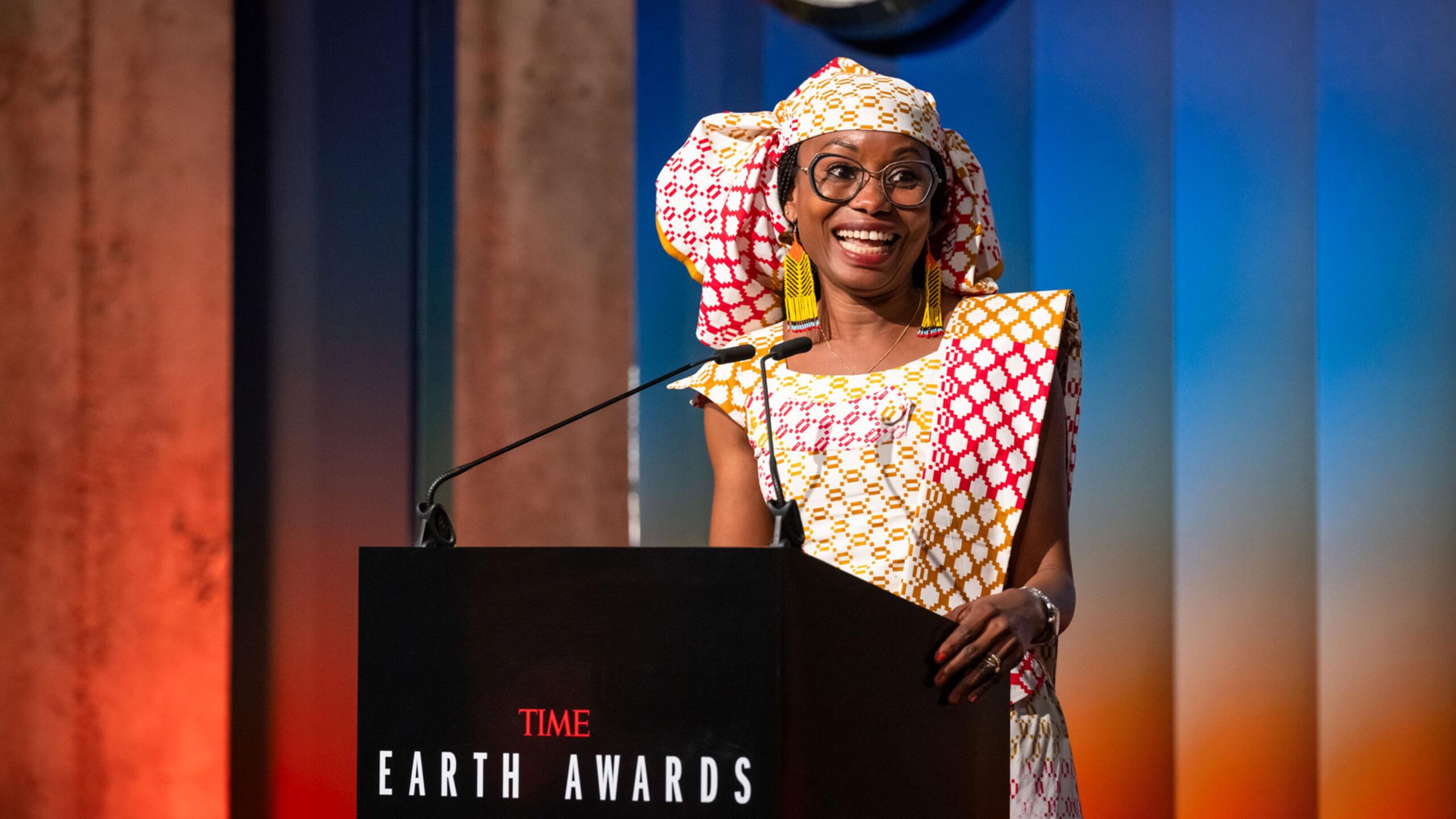
“Standing here today, I carry more than my own voice. I carry the voice of my community. I carry the voice of Indigenous Peoples. I carry the voice of those who are often unheard,” climate activist and Indigenous expert Hindou Oumarou Ibrahim said on March 26 in London as she accepted a TIME Earth Award.
Ibrahim’s dedication to addressing the climate crisis has been driven by her own Indigenous identity and upbringing. She has centered her contributions to solutions and mitigations around Indigenous values and expertise, founding the Association for Fulani Women and Indigenous Peoples of Chad (AFPAT) and amplifying their voices on the global climate stage. Partnering with the United Nations, Ibrahim has also led several important projects to improve access for Indigenous communities to basic needs, so they can better address the impact of climate change at their door.
Ibrahim grew up in a rural Indigenous community in Chad and has witnessed both past and present the challenges experienced by her community, as well as other Indigenous groups across the planet amid the climate crisis.
For Ibrahim, hope for tackling the climate crisis comes from this very community, in particular its women. “Tonight, you are not celebrating me. You are celebrating a generation of fearless women, the women who shaped me, the women who raised me, the women who taught me how I can look at the world,” she said.
Ibrahim told the award ceremony’s audience that, growing up, she walked daily to collect water with fellow women from her community. “What used to be a short journey became longer every year.” Although she was not aware of the term “climate change” growing up, Ibrahim was certainly a first-hand witness to its disastrous impact. “I saw rivers disappear. I saw families struggle to get water.” But as well as these challenges, Ibrahim also said she found hope in her community’s resilience.
“Indigenous peoples are not only on the frontlines of climate change. We are also on the frontlines of solutions,” said Ibrahim, noting how Indigenous people are central to the protection of vital ecosystems, while they only receive less than 1% of global climate finance.
The activist urged that the answer may not lie in innovation and artificial intelligence but instead in the “courage to listen.”
“Our Indigenous Peoples’ knowledge is not written in algorithms. It is written in relationships, in observation, in respect, in generations of living in harmony with nature,” she said. “Maybe, even the most powerful technology will need time to understand that.”
Read the full article here
