

The State Department has urged Americans across the Middle East to leave the region immediately due to “serious safety risks” posed by the U.S. and Israel’s war with Iran.
The advisory, posted on Monday afternoon, covers Bahrain, Egypt, Iran, Iraq, Israel, the West Bank, Gaza, Jordan, Kuwait, Lebanon, Oman, Qatar, Saudi Arabia, Syria, the United Arab Emirates, and Yemen. The State Department urges U.S. citizens in these areas to depart “using available commercial transportation.”
“Our number one priority is the safety and security of American citizens everywhere in the world,” Secretary of State Marco Rubio said in a video posted on social media in light of what he called “cowardly attacks” by Iran on Gulf states.
Rubio urged U.S. citizens to register with the Smart Traveler Enrollment Program and monitor security updates from the State Department via its WhatsApp channel and social media. He added that the department has surged personnel and resources to provide Americans with safety and security information after the U.S. and Israel launched attacks on Iran on Saturday, which Iran has responded to with missile and drone strikes across the region.
The security update came before the U.S. Embassy in Saudi Arabia was hit in a suspected Iranian drone attack early Tuesday. There have been no reported casualties or injuries from the attack so far, sources told CNN. The Saudi Ministry of Defence said it caused “limited fire and minor material damages.” The U.S. Embassy in Riyadh issued a “shelter in place” notice to Americans in Saudi Arabia on Tuesday. When asked about how the U.S. will respond to the drone attack, President Donald Trump said, “you’ll find out soon.”
Iran’s retaliatory attacks have broadened since the U.S. and Israel bombed Iran and assassinated its Supreme Leader Ayatollah Ali Khamenei over the weekend. Hundreds of people, including more than 100 children, in Iran were killed in ongoing U.S.-Israeli attacks, according to humanitarian organization Red Crescent. Iran initially retaliated with attacks on U.S. military bases in the Middle East, which has so far resulted in the deaths of six American soldiers. Suspected Iranian strikes, including intercepted projectiles, also appeared to hit civilian areas of several Gulf states, including Saudi Arabia’s largest oil refinery and a luxury hotel in Dubai, killing more than a dozen people across the region.
Read More: After Khamenei, Who Could Lead Iran Next?
On Tuesday, Iran’s Islamic Revolutionary Guard Corps said on Telegram that it was beginning to target “American political centers” in the Middle East, and that “the explosion at the Washington embassy in Riyadh, the capital of Saudi Arabia, was a move in this direction.” The U.S. Embassy in Kuwait was also hit in suspected Iranian attacks on Sunday and Monday.
The conflict has also widened as Israel and Hezbollah, an Iranian-backed paramilitary in Lebanon, exchanged attacks on Monday and Tuesday. Israel bombed Beirut again on Tuesday after killing at least 31 people in strikes on Monday, while the Israeli Air Force said it intercepted two drones from the direction of Lebanon early Tuesday after an initial attack by Hezbollah on an Israeli military base in retaliation for the assassination of Khamenei. Lebanese President Joseph Aoun condemned both Hezbollah and Israel’s attacks for “persisting in using Lebanon once again as a platform for proxy wars.”
Trump and his Administration have indicated that the U.S. plans to continue its attacks on Iran. The President told CNN on Monday morning that the “big wave” of U.S. attacks on Iran is yet to come. Rubio also told reporters on Monday that “the hardest hits are yet to come from the U.S. military” and that the “next phase will be even more punishing on Iran than it is right now,” signaling a more expansive campaign than the initial Operation Epic Fury. Trump on Monday said he would deploy U.S. troops “if necessary” although he said he “probably” would not have to. He also cautioned that there would “likely be more” American soldiers killed in the U.S. military mission, which he suggested could last four weeks.
Read More: ‘It’s As If I’m Dreaming’: Iranians Recount the First Day of the War, and the Death of Khamenei
Limited commercial travel reopens
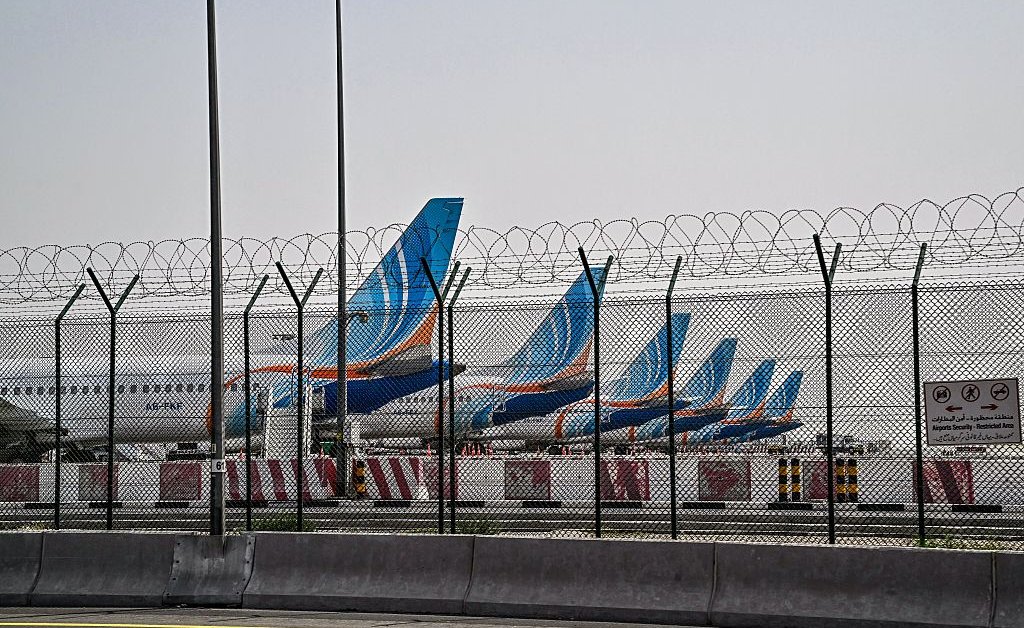
Severe travel disruptions in the Middle East may complicate efforts by Americans to leave the region, even as some commercial air travel reopened on Monday evening.
At least 11,000 flights departing from and arriving in the Middle East have been canceled since Saturday, according to aviation analytics firm Cirium. Several airlines also suspended services through the middle of this week. U.A.E. national carrier Etihad Airways suspended regular scheduled services till 2 p.m. local time (5 a.m. E.T.) on Wednesday, while Dubai-based airline Emirates suspended regular scheduled services till further notice.
Some airlines, including Emirates and Etihad, resumed some ad-hoc departures on Monday evening, mainly for repatriations. At least 16 Etihad flights departed from Abu Dhabi on Monday evening, according to flight tracker Flightradar24. Emirates also said it would resume limited flights beginning Monday evening, prioritizing customers with earlier bookings and directly contacting those who are rebooked to travel on these flights. Budget carrier flydubai also resumed a limited number of flights on Monday evening.
“Some repositioning, cargo and repatriation flights may operate in coordination with UAE authorities and subject to strict operational and safety approvals,” Etihad said.
Dubai Airports said that limited flights have been allowed to operate from Dubai International—the Middle East’s biggest travel hub—and Dubai World Central, but it urged passengers not to go to the airport unless directly contacted by an airline.
Qatar’s airspace remains closed, suspending all flights to and from Doha. Qatar’s national carrier Qatar Airways said in an update on Monday that all flight operations remain temporarily suspended until Qatari airspace is safely reopened. It said it will provide another update on Tuesday morning.
The airspaces of Iran, Iraq, Bahrain, and Kuwait remained closed as of Monday night, suspending all flights to and from those countries. Israel said it is preparing to gradually reopen its airspace next week. Jordan and Syria also partially closed their airspaces. Egypt said its airspace is fully operational, while Egyptian airlines temporarily suspended services to certain cities. Dozens of flights have rerouted through Egypt, Turkey, Oman, and Saudi Arabia, which kept most of their airspaces open, although flights bound for Riyadh have held or turned back after reports of explosions, according to Flightradar24.
How many Americans are affected?
Exact numbers are unclear, but there are roughly hundreds of thousands of Americans living across the Middle East, which could put further strain on the limited available commercial travel. Most live in Israel, with 600,000 Americans there prior to Oct. 7, 2023, according to the Washington Post. Around 15,000 Americans lived in Qatar as of 2015, 30,000 in Kuwait as of 2020, 50,000 in the U.A.E. as of 2015, 80,000 in Saudi Arabia as of 2022, and 43,000 in Lebanon as of 2023. At least 1,000 Americans and family members of Americans resided in and wished to depart Gaza in October 2023, according to a State Department briefing at the time, while around 45,000 to 60,000 Palestinian Americans lived in the West Bank, Reuters reported in July 2023. Another 60,000 live in Egypt, which has not been hit in attacks but is covered by the State Department’s security update.
These figures do not include the number of tourists, for which there is limited available data; there are also limited reliable figures for the number of Americans residing in other countries in the region. “U.S. citizens are not required to register their travel to a foreign country with us, so we cannot track how many U.S. citizens have gone to a specific country,” a State Department spokesperson told Axios in 2023.
Other countries have also issued travel warnings for the region. The British government said it was sending rapid deployment teams to the Middle East to support British nationals in the region and “ensure that they can return home as swiftly and safely as possible,” Prime Minister Keir Starmer said on Monday. The U.K. urged British nationals in Bahrain, Israel, Kuwait, Palestine, Qatar, and the U.A.E. to register their presence and monitor travel guidance. More than 100,000 British nationals have registered their presence in the Middle East so far, according to the BBC.
Read the full article here
