

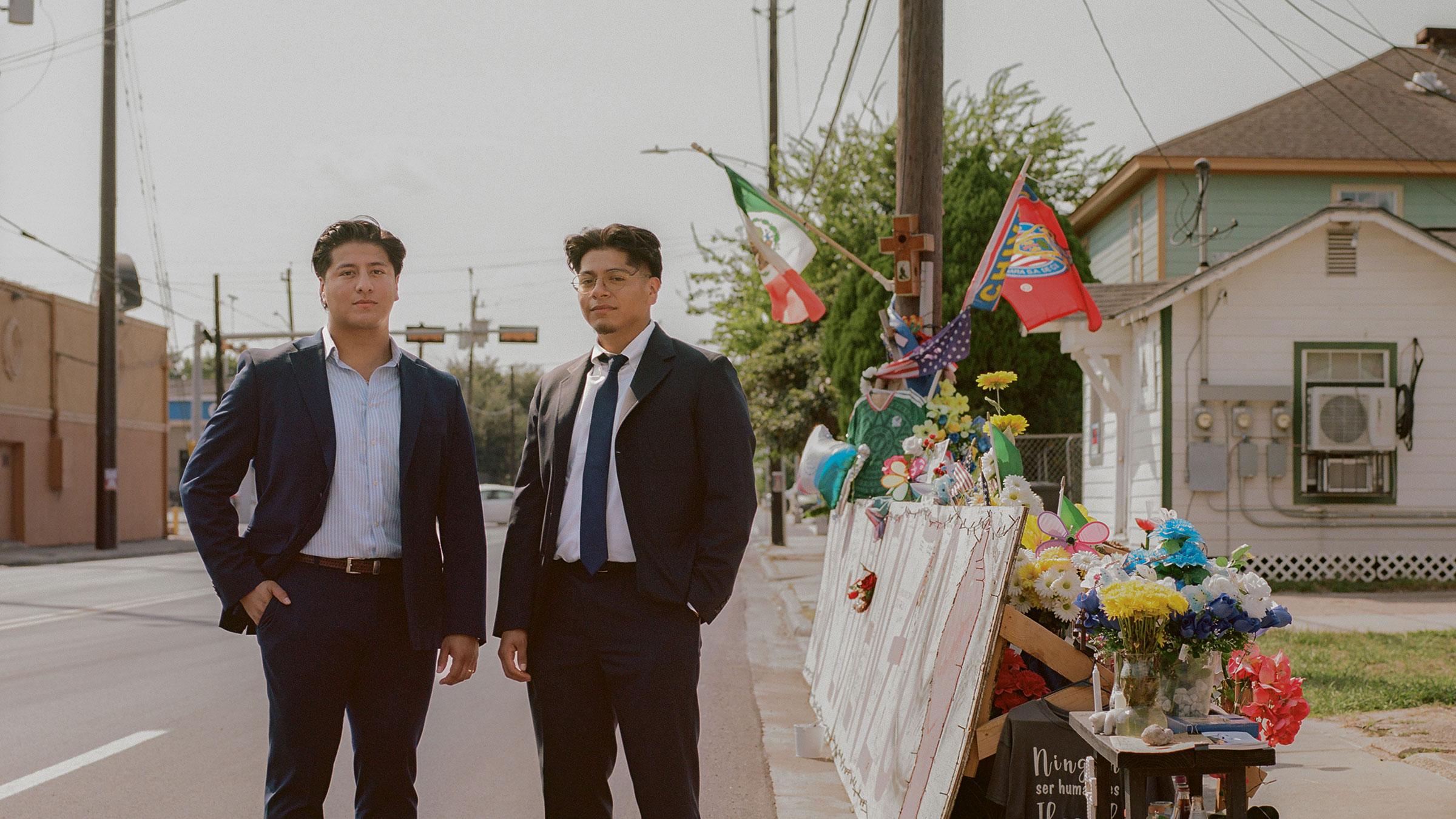
“Everyone has the inalienable rights of life, liberty, and the pursuit of happiness. For immigrants trying to achieve the American dream, regardless of status, they’re entitled to that. Also, they’re entitled to due process,” Ronaldo says. “Unfortunately, the Department of Homeland Security, specifically ICE, isn’t following through on that promise.”
A spokesperson for DHS says, “All illegal aliens receive due process. We are applying the law as written by Congress. If a judge finds an illegal alien has no right to be in this country, we are going to remove them.”
Often, family members of those detained, injured, or killed by ICE are limited in how much they can speak out, for fear of having their own immigration status examined. Ronaldo and Lorenzo Jr. were born U.S. citizens, and feel a sense of responsibility to use their voices to call for change. Ronaldo has spoken at press conferences beside politicians; he and Lorenzo Jr. have appeared on broadcast news and testified at a congressional forum. Ronaldo wants to work on state legislation that will protect immigrant communities.
“I’m trying to use that anger and channel it in a more positive way,” says Ronaldo. “I feel right now that I can’t slow down, that I have to continue taking on these meetings, doing these interviews, doing anything I can just to get my dad’s name out there, to shine a light as to what happened, to who my dad was, and the injustices that my dad experienced—that we’re still experiencing to this day.”
Salgado Araujo had the equivalent of a middle school education when he came to the U.S. His sons say his greatest pride was their commitment to education. Ronaldo, a high school geography and history teacher, was set to move to Dallas for a “dream job” on Aug. 1. He was the last son still living at home with his parents, and he looked to the examples of his brothers—Lorenzo working as an engineer in D.C., their younger brother in college in Pennsylvania—and wanted to start a life in a new city like they did. The timing made sense: his father was talking about slowing down at work, and his parents were going to enjoy more time together, to enter the next phase of life. “I always had that fear: What if they need me? But it got to a point where I was like, You know what? My mom and dad, they’re fine. They have each other, and they’ll always have each other,” Ronaldo says, voice breaking. He resigned from the job he was set to begin so he can focus full-time on the work he’s doing in his father’s memory.
“This is not anything that any of us ever imagined happening, especially to us, especially to my dad, who was a decent citizen, regardless of status,” he says. “He loved this country, regardless of how much it discriminated against him.”
Ronaldo visits the site where his father was killed at least once a day, and every day he finds someone there who wants to talk. Sometimes it’s a neighbor, but often it’s a traveler from other parts of Texas, from Arizona, from New Mexico, from Minnesota. They tell Ronaldo their immigration stories and about the loved ones they’ve lost, they say that he and his brothers remind them of their own kids, or that Lorenzo Sr. reminds them of their own fathers. A few community members have dedicated themselves to tending to the makeshift memorial, watering the flowers, bringing their dinners outside to watch over things as the day winds down.
“This is all just to try to remember a man who worked all his life to give his family a better life,” Ronaldo says, “and to give his kids something to be proud of.”
Read the full article here