

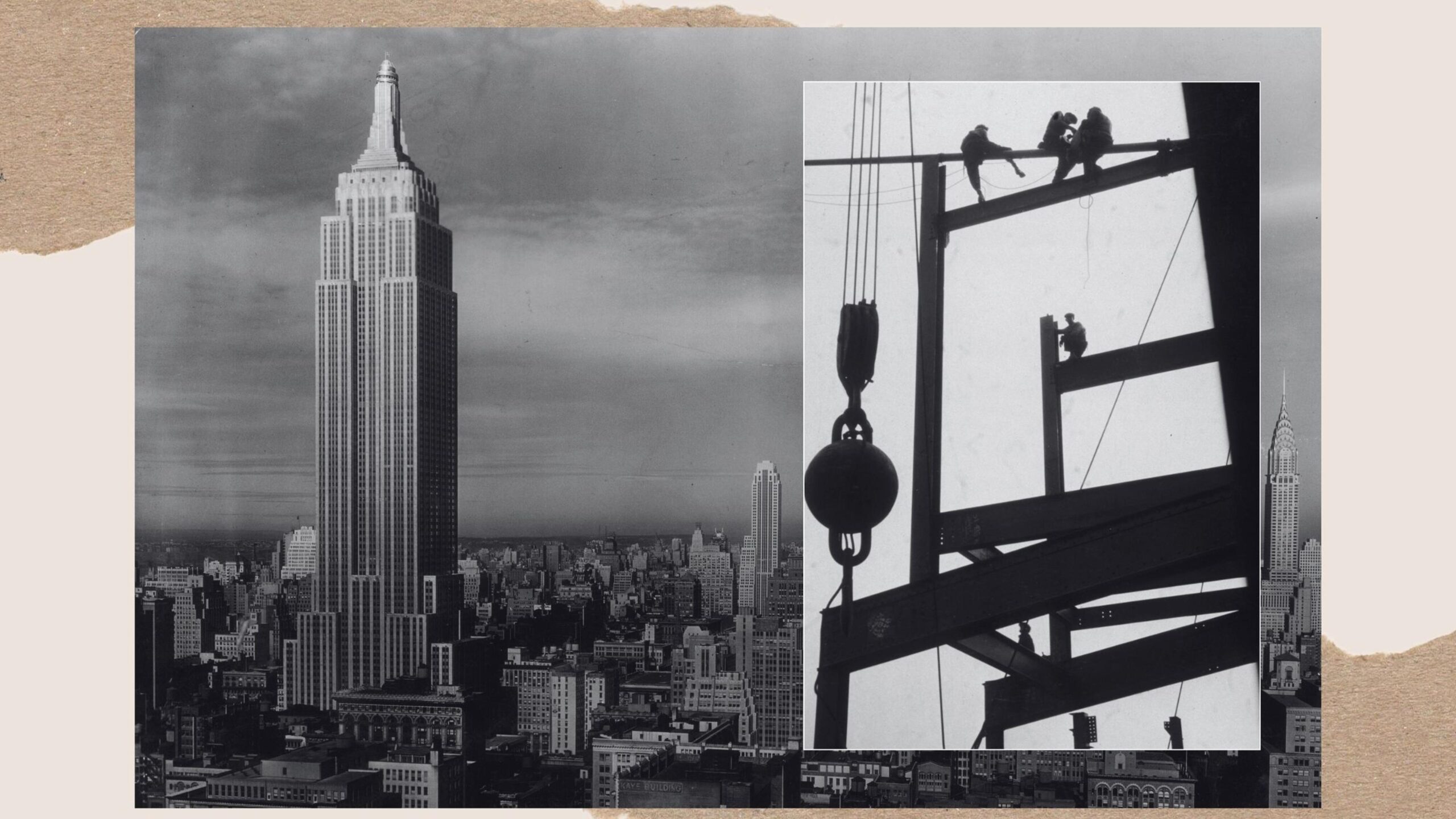
A few months before the Empire State Building officially opened, a cartoon appeared in the New York Evening Post. A mantilla-clad woman, standing with a small boy on the roof of a Lower-East Side tenement, gazes in awe at the giant skyscraper gleaming in the distance. The caption reads, “Tony, your old man’s buildin’ that.” Perhaps it was meant as a joke, the proud mother exaggerating her immigrant family’s importance. But it also spoke a truth. The nation was built by ordinary people who take justifiable pride in their contributions to America’s rise, even if those contributions are almost always overlooked.
To John Jakob Raskob, the Empire State’s primary financier and at the time one of the country’s richest men, the building represented “a land which reached for the sky with its feet on the ground.” Today, even 56 years after it relinquished the title of world’s tallest skyscraper, it remains an abiding symbol of American pride and achievement. But knowing something about the lives of the workers who built it allows us to understand more specifically what the majestic skyscraper stands for.The men who built the Empire State Building were not “anonymous workers.” They were not cartoon figures. Like the Craftsmanship Award winners, like the men pictured in Lewis W. Hine’s masterful photographs, they were Americans with names and complex histories. The building may stand in the popular imagination as the symbol of an American ideal. But for men like Owen Scanlon, Samuel Laginsky, James Irons, Adam Bigelow, Victor Gosselin, and their families, it was the very medium to realize that ideal, the pathway by which they rose into the middle class. On the 95th anniversary of their achievement, perhaps it’s time to honor these workers by name. As much as the owners, architects, and contractors, they, too, built the Empire State Building.
Read the full article here
