

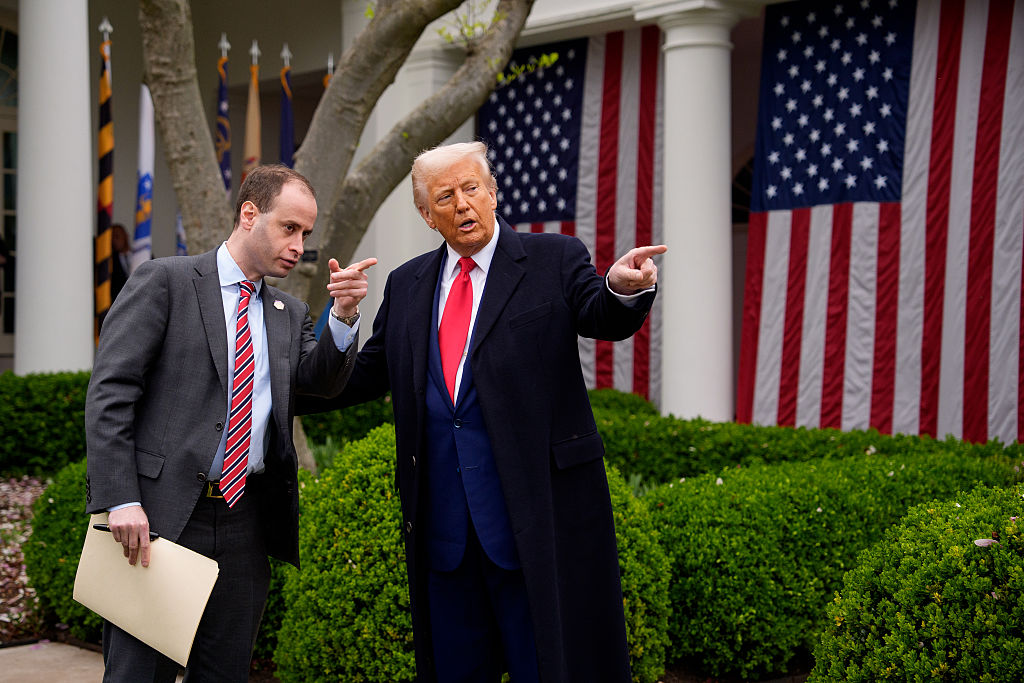
Will Scharf, who currently oversees administrative work as the staff secretary, is set to be the new White House counsel, taking over the senior West Wing position from David Warrington.
“Will is tough, strong, and smart. He also loves our country, and respects the law,” said U.S. President Donald Trump as he announced the appointment on Sunday, predicting that Scharf will do a “great job” in his new role.
Scharf will be tasked with advising the President and White House staff on legal issues, including Trump’s Executive Orders, vetoes, and other aspects of legislation. He’ll have a team of legal experts and advisers assisting him when he starts the role on Sept. 1.
According to the Center for Presidential Transition, a core duty of the White House counsel is offering advice on “matters relating to the President’s exercise of his war powers.” Trump has faced criticism across party aisles amid the Iran conflict and his failure to seek congressional approval.
As Scharf prepares to take on new responsibilities, here’s what to know about his history with Trump, his political aspirations, and more.
Scharf served as a personal lawyer to Trump during the election interference case
Scharf, who hails from New York and graduated from Harvard Law School in 2011, has served as a federal prosecutor and a clerk for two federal judges.
When announcing Scharf’s new appointment, Trump acknowledged that the conservative lawyer had also previously represented him in “numerous cases, including at the Supreme Court.” Scharf was Trump’s personal lawyer from 2023 to 2025, as Trump faced a series of criminal and civil cases in-between his two stints in the White House.
Scharf was part of the team that put forth arguments to the Supreme Court in 2024 over whether Presidents should have immunity from prosecution for actions taken while in Office.
The Supreme Court’s ruling that Presidents have broad immunity for official acts carried out in office was a big win for Trump’s team, as it effectively dismantled the federal case against Trump amid a row over whether he illegally conspired to overturn his 2020 election defeat to Joe Biden.
Scharf celebrated the ruling, calling it a “tremendous win for the Constitution” and for Trump, in a statement to the Kansas City Star. He said it had been an “honor” to represent Trump in the matter.
Scharf made an unsuccessful bid for Missouri Attorney General in 2024
After serving as an assistant U.S. attorney in the Eastern District of Missouri from 2020 to 2022, Scharf launched a bid for the Republican candidacy of Missouri’s Attorney General, going up against the incumbent Andrew Bailey in 2024.
Pointing towards the work he carried out as a federal prosecutor assigned to the Violent Crimes Unit as well as his “instrumental” role in the confirmation of Brett Kavanaugh and Amy Coney Barrett as Supreme Court Justices, Scharf honed in on his D.C. experience as he mounted his campaign.
“I’ve put hardened criminals in prison, and I’ve put constitutional conservatives on the Supreme Court. I’m ready to fight back against the woke left and out-of-control federal government to defend our rights and liberty,” read a statement from Scharf in a campaign prospectus.
In a campaign ad, Scharf claimed that then-President Biden and his legal team were “wrecking” the American legal system and “doing everything they can to stop President Trump and the MAGA agenda.” Scharf said it was time for a Missouri Attorney General “who will return fire” as he pretended to fire a grenade launcher at boxes of depicted legal documents and evidence against Trump.
In a candidate survey, Scharf said that “fighting for President Trump” was one of the three things he wanted voters to remember about his goals for office, should he be elected.
Scharf lost the Republican primary to Bailey, receiving just 37% of the vote.
Scharf was pivotal in securing Trump’s controversial White House ballroom plans
Trump appointed Scharf as the at-large commissioner to the National Capital Planning Commission in July 2025.
The President appointed several members of his Administration to the Commission as he sought overview of the renovations to the Federal Reserve building under former Fed chair Jerome Powell.
In the position, Scharf has played a pivotal role in bringing Trump’s controversial White House ballroom plans to life.
Trump has faced widespread criticism for demolishing the East Wing of the White House to make room for the grand ballroom design.
Scharf defended the project in April, insisting “the only constant in the history of the White House is that practically every change, every modification, every addition, and indeed every feature that we now celebrate as an iconic aspect of the White House was roundly and viciously condemned in its day.”
“Any argument that relies on the idea that the White House is unchangeable or should be unchangeable flies in the face of the very history of the structure such critics claim they are trying to protect,” he added.
Despite the Commission’s arguments, the construction of the $400 million ballroom—a space Trump insists is essential for security purposes—continues to face legal challenges.
A federal appeals court on Aug. 7 ruled that the construction of the ballroom could not continue without congressional authorization. Trump has said he intends to appeal the matter to the Supreme Court.
Read the full article here
