

Conservative commentator Tucker Carlson has long been regarded as a strong ally of President Donald Trump and a leading voice within the MAGA coalition.
Although there were historic indications of Carlson not being a fan of Trump’s, the tide had turned before the latter launched his campaign to return to the White House.
At the Republican National Convention in July 2024, Carlson referred to the President as a “wonderful person” and told the crowd that Trump’s survival of the assassination attempt in Butler, Pennsylvania, some days earlier amounted to “divine intervention.” He said that moment, months before the presidential election, had already defined Trump as “leader of this nation.”
But that kinship has since become strained and appeared to reach a breaking point earlier this week, when Carlson—during an episode of his political commentary podcast—expressed regret over ever having supported Trump.
Joined on The Tucker Carlson Show by his brother Buckley, a former speechwriter for Trump, Carlson apologized to his audience for “misleading” them.
“I mean you, and I, and everyone else who supported him, you wrote speeches for him, I campaigned for him. We were implicated in this for sure,” Carlson said to his brother. “We’ll be tormented by it for a long time. I will be, and I want to say I’m sorry for misleading people, it was not intentional.”
The strong statement came after weeks of heightened tensions between Carlson and Trump, who express polar opposite views regarding how to approach Iran.
The disagreement resulted in Trump publicly berating Carlson by referring to him as “kooky,” but they swiftly mended ties, with the President telling reporters that Carlson had called to apologize.
But Trump’s decision to join forces with Israel once more and launch strikes against Iran on Feb. 28—and the subsequent war that has followed—prompted another major fallout between the once-close allies.
And it’s no longer solely matters related to Iran that are splintering relations.
Here’s a look at some of the recent key disagreements and clashes that led to Carlson publicly severing ties with the President he once championed.
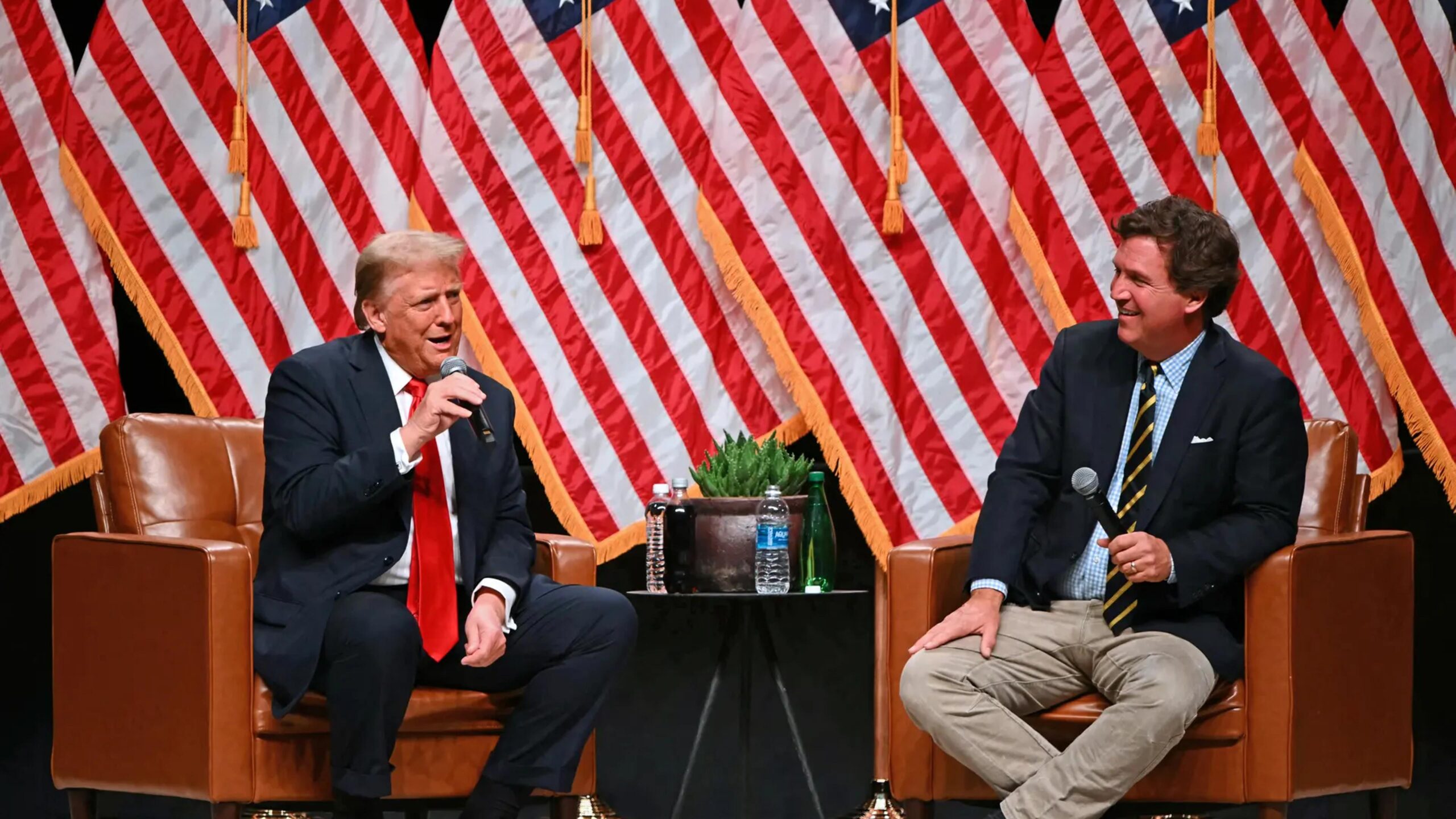
Tucker Carlson speaks before Trump takes the stage during a campaign rally at Madison Square Garden in New York City on Oct. 27, 2024. Michael M. Santiago—Getty Images
Carlson’s strong opposition to Trump going to war with Iran
Carlson has emerged as one of the most prominent voices on the right opposing U.S. military intervention against Iran.
That opposition has earned him Trump’s wrath.
Earlier this month, the President rebuked Carlson alongside other right-wing figures who have broken with him over the Middle East conflict.
“I know why Tucker Carlson, Megyn Kelly, Candace Owens, and Alex Jones have all been fighting me for years, especially by the fact that they think it is wonderful for Iran, the number one state sponsor of terror, to have a nuclear weapon—because they have one thing in common, low IQs,” he claimed. “They’re stupid people, they know it, their families know it, and everyone else knows it, too!”
Trump continued his attacks on Carlson on April 16, while also targeting Joe Kent, the former Director of the National Counterterrorism Center who resigned in March in protest of the U.S. entering a war with Iran.
“Who’s dumber, Tucker Carlson or Joe Kent?” Trump said. “Kent is a loser, just like Tucker, Candace, Megyn, and the rest of them are losers.”
After his resignation, Kent made his first major public appearance on Carlson’s podcast, where the pair discussed their opposition to the Iran war and claimed the conflict had been carried under the influence of Israel—a theory Carlson has long pushed and one that Trump has denied.
Carlson questions if Christians should have reconsidered support for Trump over Venezuela operation
In January, Trump announced that Venezuelan leader Nicolás Maduro and his wife, Cilia Flores, had been captured from his residence in Caracas by American special forces and taken to New York to face criminal charges.
Since then, Delcy Rodríguez has been sworn in as the country’s interim President and established what some have described as a more compliant relationship with the U.S., giving Washington greater control over major oil hubs in the region.
Reflecting on the military operation earlier this month, Carlson argued that this should have been a moment for fellow Christians to reconsider their support for the President.
He described Maduro as an “anti-American leader and a socialist, not someone most Americans liked or really had cause to like,” but claimed Trump’s justification for removing him, in part tied to Venezuela’s oil, was unacceptable.
“That’s not acceptable for Christians. In fact, that’s unacceptable for Americans or any civilized people because taking other people’s stuff by force cannot be allowed,” he argued.
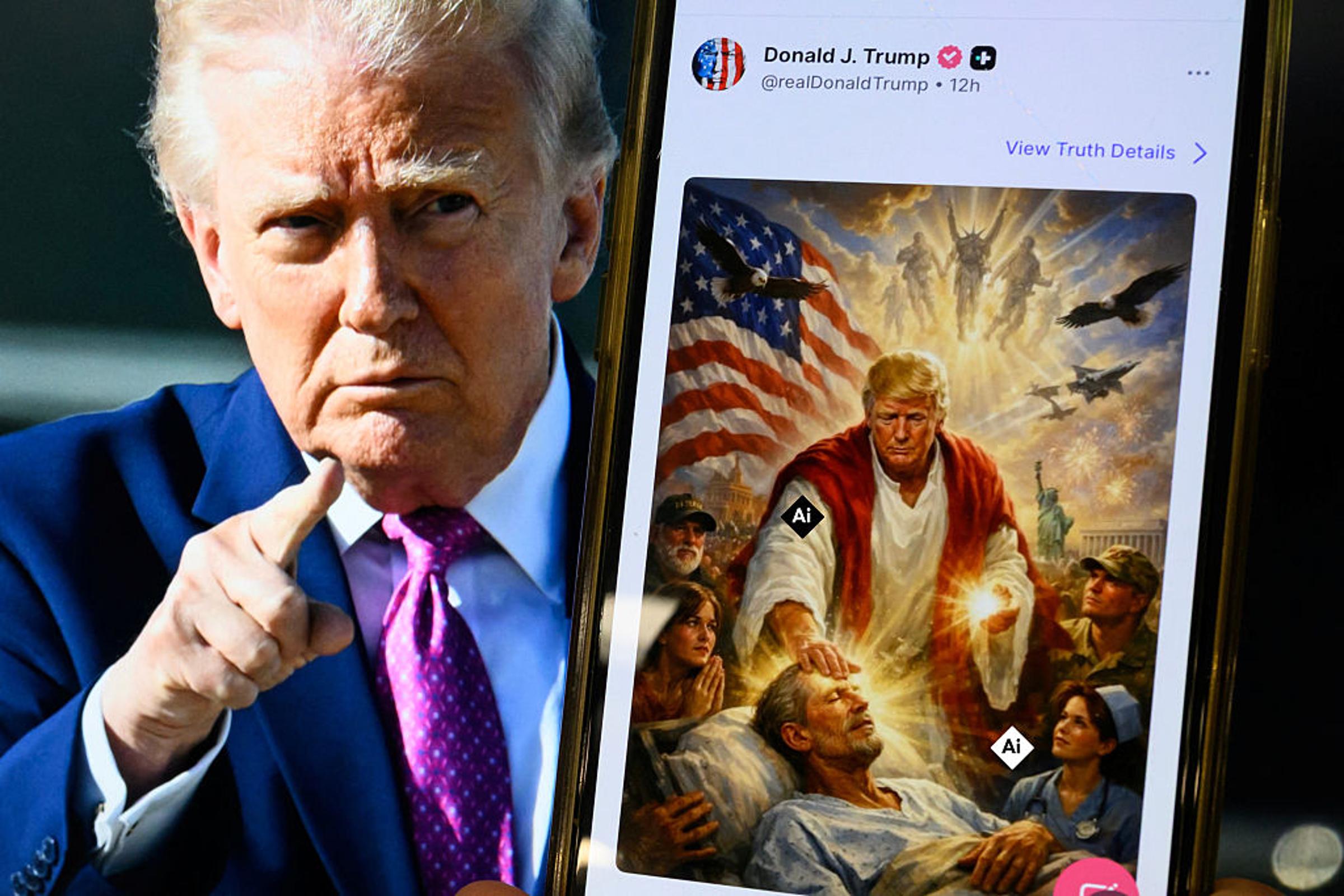
U.S. President Donald Trump and an AI-generated picture he posted on his Truth Social platform, seemingly depicting himself as Jesus Christ. Mandel Ngan—Getty Images
Carlson says Trump’s threats against Iranian infrastructure on Easter Sunday could constitute a “war crime”
One of Carlson’s fiercest critiques of Trump came after the President threatened to target Iranian civilian infrastructure if Tehran did not reopen the Strait of Hormuz, a vital waterway through which roughly a fifth of global oil supply passes.
“Tuesday will be power plant day, and bridge day, all wrapped up in one, in Iran. There will be nothing like it! Open the f–kin’ Strait, you crazy b-stards, or you’ll be living in hell. Just watch. Praise be to Allah,” Trump warned.
Carlson described Trump’s words as “vile on every level.”
“It begins with a promise to use the U.S. military, our military, to destroy civilian infrastructure in another country, which is to say to commit a war crime, a moral crime, against the people of the country,” Carlson said.
He particularly took issue with Trump’s language falling on Easter Sunday, one of the most important days in the Christian calendar.
“How dare you speak that way on Easter morning to the country. Who do you think you are? You’re tweeting out the F-word on Easter morning,” he said.
Carlson also rejected Trump’s use of “Allah,” framing it as “mocking the religion of Iran.”
Carlson criticizes Trump over posting of Jesus-like image
Carlson was among the conservatives who rebuked Trump for sharing an AI-generated Jesus-like image of himself as a robed figure with light emanating from his hands.
The now-deleted image was posted on social media after Trump lambasted Pope Leo, following the Pontiff’s call for an end to the Iran war.
Trump insisted it wasn’t intended to be a Jesus-like depiction, stating he thought the image painted him as a doctor, but Carlson rejected the explanation.
The President later shared another AI-generated image of himself being embraced by Jesus, which Carlson described as a “mockery” of religion.
Read the full article here
