

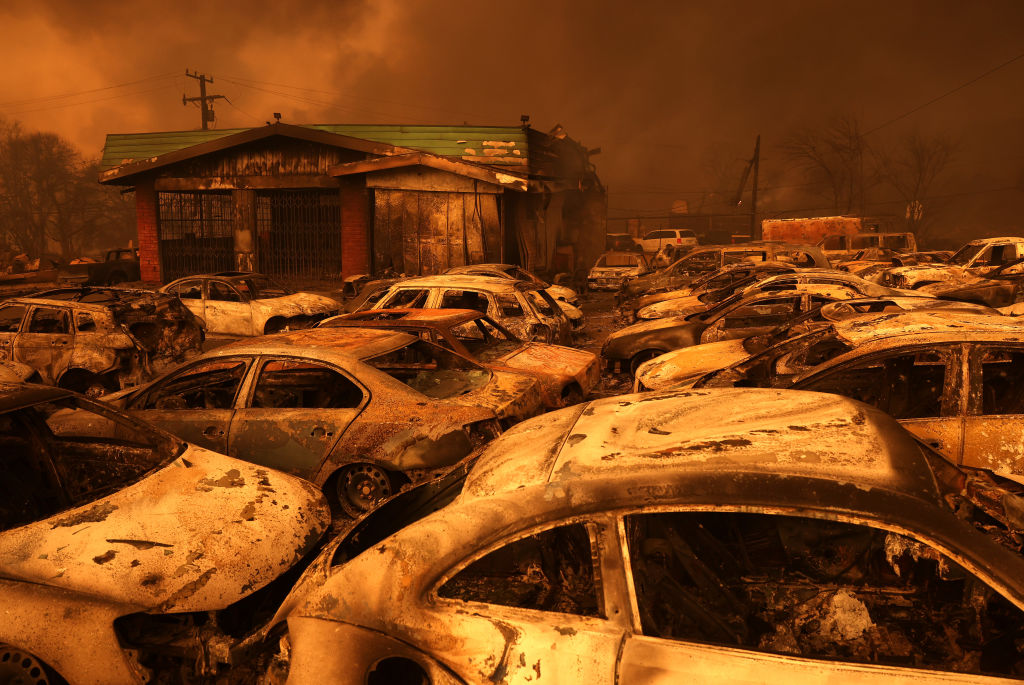
The Los Angeles County Fire Department on Tuesday found the utility company Southern California Edison (SoCal Edison) responsible for the Eaton Fire, which ravaged more than 14,000 acres, destroyed over 9,000 homes and businesses, and killed 19 people in the cities of Altadena and Pasadena, California, in January 2025.
“After 18 months of thorough review of all evidence, alongside retained electrical and metallurgical experts, the investigation concluded that the cause of the wildfire conflagration was due to the electrical arcing events that took place on the out-of-service Southern California Edison (SCE) tower,” the new report said.
It went on to explain that faulty transmission equipment shed sparks, which in turn ignited dry brush surrounding the tower on Jan. 7. The ensuing blaze, which quickly spread amid powerful Santa Ana winds and extremely dry conditions, led to a monthlong battle for local firefighters while stretching emergency resources as crews simultaneously fought the Palisades Fire.
The Palisades Fire, which also ignited on Jan. 7, stretched over 23,000 acres and killed 12 people, while destroying nearly 7,000 structures. Federal prosecutors allege the fire was intentionally set, and a suspect was identified in October 2025. In the subsequent year, he was arrested and his case resulted in a mistrial in June. A retrial is scheduled to take place this October, but the question remains whether it will provide any additional answers for the tens of thousands affected by the blaze.
With both cases at a turning point, California residents may be hoping to finally get answers about the events leading to one of the most catastrophic chapters in the state’s wildfire history. But will they also get the justice they are seeking?
What comes next in the Eaton Fire investigation?
SoCal Edison quickly acknowledged that its equipment most likely caused the Eaton Fire. In reports to the California Public Utility Commission in January 2025, SoCal Edison said it had detected a “fault” on one of its transmission lines.
Kathleen Dunleavy, a spokesperson for SoCal Edison, told TIME that the utility company is reviewing the report, and the findings are “generally consistent with what [the company has] been saying regarding the ignition of the Eaton Fire.”
“As we have said, Edison believes that it’s likely that its own equipment was associated with the start of the Eaton Fire,” she says. However, it is “definitely” not just the equipment to blame for how intense the fire became.
“A fire of the size and magnitude of Eaton is rarely the result of just one thing,” she explains.
With nearly 1,000 lawsuits against SoCal Edison from the families of the deceased, as well as those who lost their homes in the fire, the company filed its own countersuit in January 2026, accusing Los Angeles County, local water agencies, and the Southern California Gas Company of failing to warn residents about or prevent the spread of the fire.
The Los Angeles County District Attorney’s Office told the Associated Press that it is planning on reviewing the latest investigative report, and will work with local, state, and federal authorities to determine if criminal charges are warranted.
What comes next for the arson suspect in the Palisades Fire?
In June, the case against accused arsonist Jonathan Rinderknecht, who federal prosecutors say is responsible for the Palisades fire, ended in a mistrial, with 10 of 12 jurors leaning toward a verdict of not guilty. The retrial is scheduled for Oct. 19, according to U.S. District Judge Anne Hwang, who presided over the first.
Though the suspect is due back in court in October, it’s unclear if anything will change in prosecutors’ handling of his case.
At the time, they did not provide direct evidence that Rinderknecht started the Palisades Fire. Instead, prosecutors argued that he was in the area when the fire ignited and was motivated by resentment toward its wealthy residents.
His defense, meanwhile, suggested that fireworks were a more likely culprit than Rinderknecht.
One juror, identified only as Syrena, spoke with the Associated Press in June, claiming that there was “just not enough proof.”
For victims of the Palisades Fire and their families, the October retrial could offer the next opportunity for answers—and, potentially, accountability.
Read the full article here
