

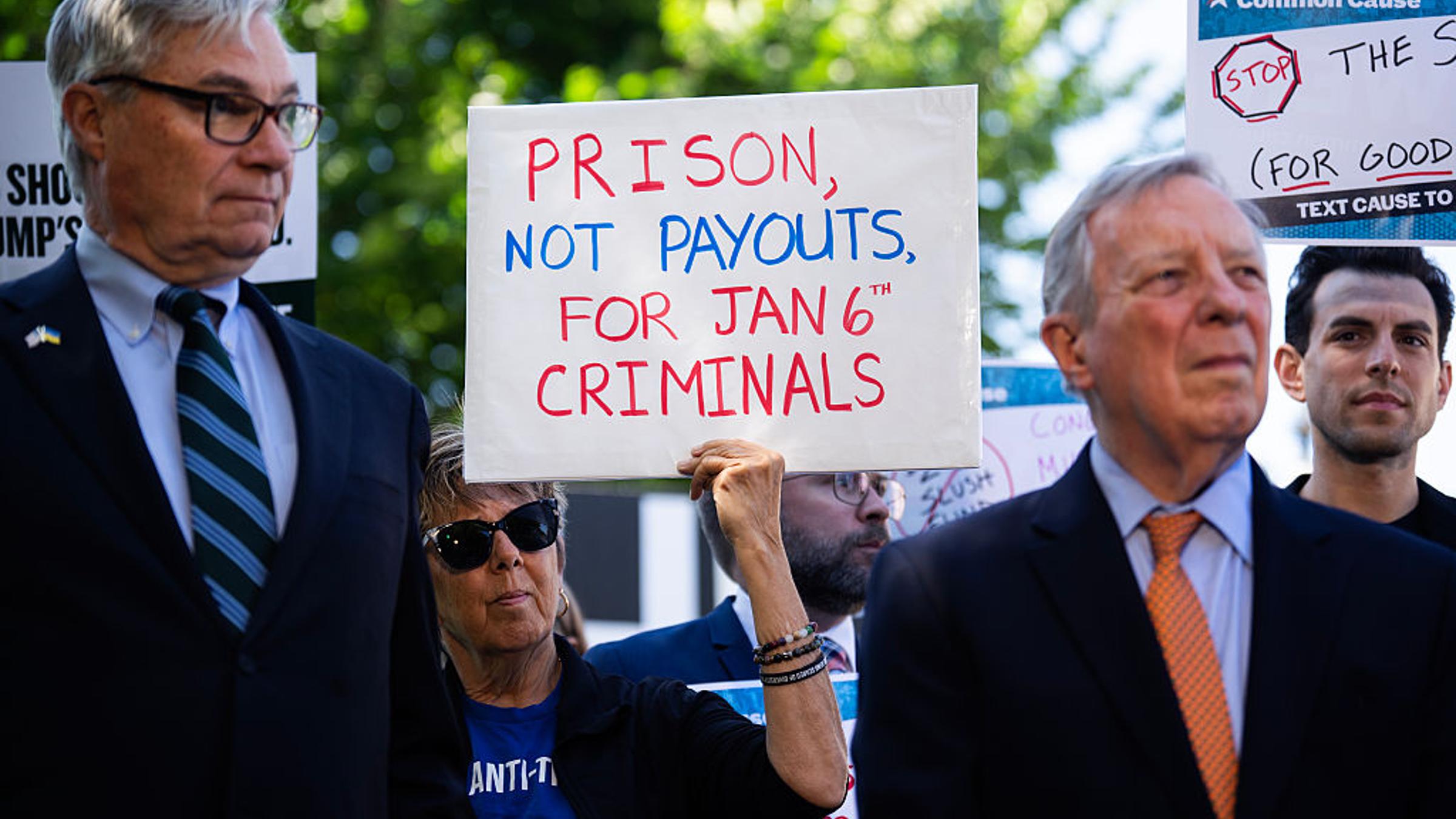
The Justice Department said it would cancel plans to create a $1.8 billion “anti-weaponization fund” that critics feared would have gone to loyalists of President Donald Trump.
On Tuesday, Acting Attorney General Todd Blanche testified that the DOJ would not move forward with plans for the fund, which was intended to compensate people who claimed to have been targeted by the “weaponization” of President Joe Biden’s government. It was the first time that an official publicly confirmed the DOJ would scrap the fund entirely after backlash from both Republicans and Democrats over concerns that it would serve as a “slush fund” for Trump’s allies and supporters, including those who participated in the Jan. 6, 2021, attack on the Capitol. Legal experts also said the fund lacked a clear legal basis, with no judicial review or congressional oversight.
“We are not moving forward with the fund, period,” Blanche told the House Appropriations subcommittee. In response to questions from Rep. Grace Meng (D, NY), Blanche confirmed that the DOJ planned to drop the plans forever.
The fund was part of a controversial settlement of Trump’s $10 billion civil lawsuit against the Internal Revenue Service over the 2019 leak of his tax returns by a former contractor.
After a federal judge temporarily blocked the fund last week, the DOJ said on Monday that it disagreed with the ruling but would abide by it.
Democrats and even some GOP lawmakers pushed to formally block the creation of the fund, but Senate Republicans narrowly voted down multiple efforts to strike it from a massive Trump-backed immigration enforcement package on Thursday.
An attempt, led by Democratic Leader Chuck Schumer, to amend the bill to codify Blanche’s promise failed 49-50. The vote extended for hours due to initial GOP holdouts.
Senators also rejected an effort by Sen. Thom Tillis (R, N.C.) to redirect the funding towards “fraud enforcement” at the DOJ, which Democrats said would still be a politicized use of taxpayer money.
“If Blanche says that this is largely inoperative, why not use this moment to codify that? Otherwise, you’re exposing every one of our members who are in cycle to having to deal with this between today and Election Day, and that makes no sense,” Tillis said before the vote. Tillis, who has bucked his party and opposed Trump on multiple occasions, said in June that he does not plan to run for reelection. Tillis refused to vote for the bill if it did not include language to permanently bar the fund.
The fund could face at least one other challenge from Sen. Bill Cassidy (R, La.), who said he intends to offer an amendment to ban payouts from the settlement. Cassidy lost his bid for reelection in the Republican primary last month to a Trump-endorsed challenger. Republican leaders told the Associated Press that amendments restricting the settlement could endanger the bill’s passage in the House, risking another legislative impasse like the stalled Homeland Security funding legislation that led to a partial government shutdown in March.
Concerns that the Administration might resuscitate the fund in future have grown since Blanche refused to formally renounce the fund.
Blanche told Meng on Tuesday that he was not “committing to putting anything in writing” to rescind, amend, or reissue the DOJ’s May 18 press release announcing the fund.
“I’m just concerned because you’re not under oath,” Meng said. “I want to trust you, and I want to believe you. We all do, but putting it in writing would settle that issue.”
“I don’t know what the purpose of putting something in writing. I’m telling you what we’re doing,” Blanche said.
The “reasons for the fund,” he added, “remain as important as they were before, but we are not moving forward with the fund.”
On Wednesday, Trump injected more uncertainty into whether the Administration might try to revive the fund in the future. The President told CNN that he’d “have to ask the lawyers” about whether its creation was scrapped entirely or just put on hold.
“As far as I’m concerned,” Trump said of the fund, “it was a beautiful thing.”
Bipartisan pushback against the fund
A bipartisan group of 35 former federal judges filed a motion in late May asking a federal judge in Miami to reopen the settlement case and review whether the fund was “a product of collusion and is itself a fraud on the court.” The settlement was not made public until after U.S. District Judge Kathleen Williams granted a voluntary dismissal of the case on May 18. On May 29, Williams launched an inquiry after receiving the third-party motion. The same day, a federal judge in Virginia, Leonie Brinkema, paused the creation of the fund.
Pushback against the fund from both Republicans and Democrats grew after Trump officials refused to rule out payments to Jan. 6 rioters who assaulted police officers. Vice President J.D. Vance said last month that the Administration would consider compensating Jan. 6 defendants on a “case-by-case basis.” Blanche had also said during a Senate Appropriations subcommittee hearing on May 19 that “anybody can apply” for compensation through the fund.
The Trump Administration has taken several steps towards absolving nearly 1,600 people who were criminally charged or convicted in relation to the Capitol attack. On the first day of his second term, Trump granted blanket clemency to nearly all individuals convicted of or charged with offenses related to the insurrection. Last month, the DOJ asked a federal appeals court to vacate seditious conspiracy convictions of the leaders and members of far-right groups, who had their prison sentences commuted by Trump’s move but did not receive full pardons. Also last month, the DOJ removed hundreds of news releases related to the prosecutions from its website.
The White House also published a page on its website describing defendants as “unfairly targeted, overcharged, and used as political examples” and characterizing the attack as a security failure by the Democrats. The page also repeated claims of a “fraud-ridden election,” which have been widely discredited.
The Trump Administration has also repeatedly accused the Biden Administration of “political weaponization” of federal agencies, including the Justice Department. Biden officials have denied the allegations. At the same time, Trump has urged the DOJ to investigate his perceived foes, including former Fed Chair Jerome Powell, New York Attorney General Letitia James, and Sen. Adam Schiff (D, Calif.). Those cases either did not result in charges or were dismissed. The DOJ also indicted former FBI Director James Comey in late April over a purported threat to Trump, after an earlier indictment of him was dismissed.
Republican opposition to the fund stalled progress on a $70 billion funding package for immigration enforcement agencies, which Democrats are universally opposed to.
After initially appearing to resist pushback last month, the DOJ said it would comply with the temporary pause on the fund, and reports suggested that the Administration was amenable to discarding the plans.
Still, several Republicans said they needed to hear a clear promise to abandon the fund before they would move forward with the bill. Senate Republican leaders are now pushing for a vote on the bill as soon as Wednesday, sources told CNN.
Protections from I.R.S. audits remains
The settlement also “forever barred” the I.R.S. from auditing past tax returns of Trump, his family members, or their companies. “Nothing has changed” in terms of those protections, Blanche said on Tuesday.
The tax term was scrutinized by Democrats at Tuesday’s hearing.
“What you’re doing on this is that you’ve taken one piece and you said, ‘Okay we have had a ton of backlash on this $1.8 billion slush fund, however, so we’ll not move on that,’ but as part of the settlement, which is this immunity for the President and his family and his business, etc. that stands,” Rep. Rosa DeLauro (D, Md.) said. “Simply put, you just gave the President and his family a tax immunity to the tune of about $100 million.”
Blanche defended the tax term, which had been included in an addendum to the DOJ’s announcement of the fund and not separately announced.
“It’s standard, it’s typical to get rid of past ongoing audits. It’s not a forward-looking document,” Blanche said. “It’s nothing that gives any sort of immunity in the future to the president or his family or his organizations.”
DeLauro, however, said the term exempted Trump “from any accountability.”
“If the President, his associates, and family members were innocent of whatever they were being investigated for, the investigation would surely bear that out,” she said. “But now we will never know.”
Read the full article here
