

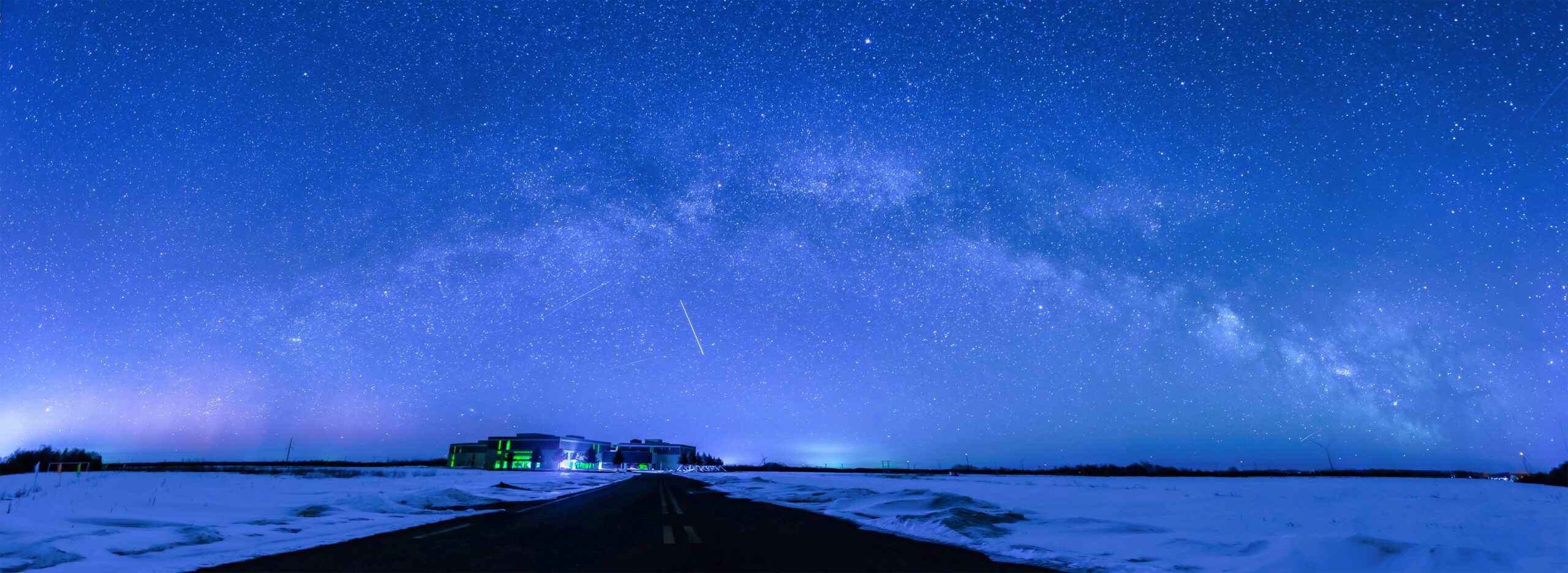
Human activity can already dam rivers, clear-cut jungles, irrigate deserts, and change the very climate. Now, our technology may be on the doorstep of turning nighttime to day. That’s the word out of Washington, where the Federal Communications Commission (FCC) just approved a proposal by the Hawthorne, Calif.-based company Reflect Orbital to loft a satellite with a 60-ft. wide mirror that will catch and beam sunlight back to the Earth, artificially illuminating a patch of otherwise-dark ground.
The launch, which could take place this summer, is just a beta test of the basic technology, but Reflect Orbital—which bills itself as “The Sunlight Company”—has big things in mind. If this first satellite proves itself, mission planners envision lofting 36 satellites by next year, 5,000 by 2030, and a staggering 50,000 by 2035.
“We’re grateful to the FCC for recognizing the importance of testing novel technologies in space,” said Ben Nowack, co-founder and CEO of Space Orbital, in a statement. “This license is the first step toward rigorously testing our technology’s efficacy and the safeguards we have developed.”
Read more: What We Lose When We Can’t Stargaze
The company envisions multiple uses for sun-reflecting satellites: assisting search and rescue operations, allowing construction projects to operate around the clock, charging solar power stations, increasing crop yield. But critics cite all manner of risks. Human and animal circadian rhythms could be badly affected if the sun—or a simulacrum of it—never sets. The practice of changing the clocks by a mere hour twice a year is already known to mess with human sleep-wake cycles, after all. Plants could bloom when they shouldn’t and die before their time. Orbital mirrors flashing and winking back to Earth could distract airline pilots. Finally, light pollution is already interfering with astronomical observations—a problem made even worse by satellite constellations like SpaceX’s 10,000-strong Starlink fleet. Reflect Orbital’s 50,000 birds would dwarf even that.
“Astronomers worry that a constellation of orbital mirrors like Reflect Orbital is planning might compromise the ability to view the night skies,” says John Logsdon, professor emeritus at George Washington University’s Elliott School of International Affairs, where he was long-time director of the school’s Space Policy Institute.
Nowack disagrees. “From the beginning, we’ve been designing our satellites to be very precise,” he tells TIME. “We want to precisely control where our sunlight is going, and we only want to light up areas that want that sunlight.”
The company’s initial efforts will be modest. The first satellite, named Eärendil-1—after the Old English word for morning star—will shed only as much light as a full moon, across a 6,000-acre area, or about the size of an airport. And that faint illumination will not last long—just five minutes before the satellite, which will be orbiting 400 miles up at 17,500 miles per hour, moves out of range. But if the first launch succeeds, those metrics could change fast. By next year, the 36 satellites that are projected to be aloft will be able to reflect down the equivalent of nighttime street lighting, with multiple mirrors at different spots in orbit cooperating to provide 2.5 hours of light. The 5,000 satellites planned for 2030 will produce the equivalent of daylight for a few minutes at a time, the equivalent of indoor lighting for up to two hours, and all-night street lighting. And the 50,000-strong flock in 2035 will produce an as-yet unspecified number of hours of daylight illumination and ‘round the clock indoor-level lighting to customers who request it.
Nowak’s claims that the artificial lighting will be precisely limited to specific spots notwithstanding, there is certain to be some spillover to areas outside the intended footprint of light—thanks to our atmosphere. Air molecules reflect and scatter light beyond an immediate beam, which is why the sky starts brightening at dawn even before the sun climbs above the horizon. Things are different on a world like the moon, with no atmosphere; there, the transition from daylight to nighttime operates like a light switch in a darkened room—bright one second, black the next. Not so here.
“The atmosphere is dynamic and turbulent, catching, throwing, and bouncing photons like mobile trampolines; that’s what gives us effects like stars twinkling at night,” says Lindsay DeMarchi, a policy analyst with The Aerospace Corporation’s Center for Space Policy and Strategy. “That’s many opportunities for interactions … to spread out or scatter light as photons travel from space to Earth’s surface.”
The astronomical community is mobilizing against Reflect Orbital. In a letter sent to the FCC on June 2—prior to the agency’s approval of the company’s operations—the American Astronomical Society (AAS) sought to halt the upcoming launch, citing the light pollution problem, the potential for eye damage if amateur astronomers view the satellite through a telescope, the risk to pilots and drivers who might be distracted or temporarily blinded by the artificial light, and the waste of federal research dollars if the work of government-funded observatories is compromised. The group sought to distinguish Eärendil-1 from other satellites, which also unavoidably reflect some light and yet routinely receive FCC approval.
“AAS opposes the granting of a license to Reflect Orbital, because this application is fundamentally different from those for telecommunications satellites,” the letter argued. “The proposed satellite would be intentionally reflecting sunlight to Earth and is designed to be as bright as possible, making impacts on astronomical research extremely challenging to mitigate.”
Nowack stands by his insistence that incoming light from his satellites will be finely focused, while also promising that in some cases he’d be willing to refuse service to a potential customer if someone on adjacent land objected. “If there’s a case where we want to serve a customer, but there’s a [person] nearby that doesn’t want the light, generally we’re not going to serve that customer,” he says.
He also argues that the satellite constellation he proposes to place in space could save lives here on Earth. “During the Venezuelan earthquakes,” Nowack says, “a dozen people reached out and said, ‘Hey, when it got dark, it was really hard to find people in the rubble. Is there any way you could light up the area and help aid emergency responders in saving all these lives?’”
For better or worse, the space mirror is coming—and potentially soon. Since the human species was born, it has lived under the canopy of the stars. Now we are preparing to change that canopy.
Read the full article here
