

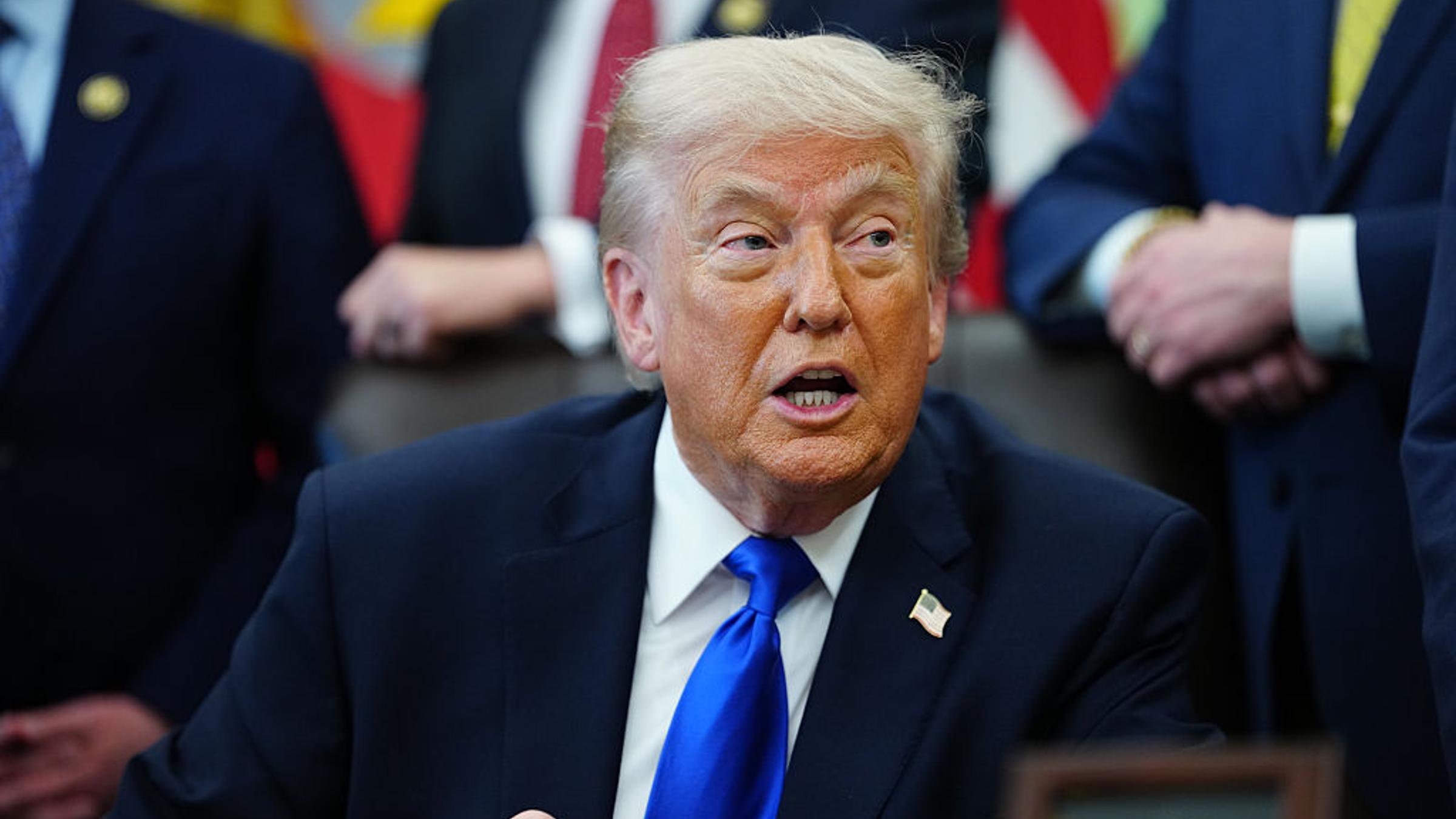
President Donald Trump on Wednesday signed a new counterterrorism strategy that places drug cartels in the Western Hemisphere and loosely defined “left-wing” domestic extremist movements at the center of U.S. national security priorities.
The strategy expands the traditional definition of terrorism beyond Islamist militant groups to include transnational criminal organizations and what the Administration describes as “violence-secular political groups” such as Antifa. It marks a significant departure from both Trump’s counterterrorism blueprint from his first term and the approach of the Biden Administration.
“We are taking ideology and counter-ideology very seriously,” Sebastian Gorka, the senior director for counterterrorism at the National Security Council, said in a telephone call with reporters to announce the strategy. “Whether it’s against Western civilization, America, the U.S. Constitution, our friends, our allies, peace in general.”
The focus on left-wing groups amounts to a reversal from U.S. policy under the Biden Administration, which made a point of emphasizing the threats of domestic terrorism linked to far-right and white supremacist ideologies. Gorka described a “resurgence of violent left-wing ideology” and pointed to the murder last year of conservative activist Charlie Kirk. “Americans have witnessed politically motivated killings of Christians and conservatives increase, committed by violent left-wing extremists, including the assassination of my friend, Charlie Kirk, by a radical who espoused extremist transgender ideology,” he said.
However, an analysis conducted last year by the bipartisan Center for Strategic and International Studies illustrates the imbalance in recent threats: over the past decade, right-wing extremists carried out 152 attacks in the United States and killed 112 people, compared with 35 attacks and 13 deaths attributed to left-wing extremists. Jihadist-inspired attacks accounted for 82 deaths over the same period.
Since the Sept. 11, 2001, attacks, Presidents have released strategy documents outlining their administration’s approach to counterterrorism. They serve not only as internal planning documents but also as signals to allies and adversaries about U.S. priorities. By elevating cartels and Antifa alongside jihadist groups, the Trump Administration is effectively redefining what the federal government constitutes as a terrorist threat.
One of the most consequential tools in that effort is designating a group a foreign terrorist organization (FTO). Traditionally reserved for groups that engage in politically motivated violence against civilians and threaten U.S. national security, the designation imposes sweeping financial sanctions and makes it a crime for Americans to provide material support to listed organizations. It can also expand surveillance and investigative authorities.
The Trump Administration has already applied the FTO designation to several Latin American drug cartels, including Tren de Aragua and the Sinaloa Cartel, and is moving to add a number of left-wing groups in Europe. Gorka said the President had also taken the “historic” step of designating the Muslim Brotherhood as a foreign terrorist organization, describing it as “the progenitor” of modern jihadist movements.
“Jihadi terrorists have likewise continued to plot against and kill Americans,” Gorka said, outlining a second pillar of the strategy focused on dismantling Islamist groups, including Al Qaeda and regional affiliates of ISIS.
The document’s release comes months after the Trump Administration released an updated national security strategy that elevated the Western Hemisphere to the top of U.S. foreign policy priorities. Since then, Trump has aggressively reshaped the balance of power in the region, carrying out dozens of strikes on suspected cartel-linked vessels in the Caribbean, removing Venezuela’s Nicolás Maduro from power, and threatening Cuba’s communist government. The actions have signaled a more direct and militarized U.S. posture in Latin America, with counter-narcotics operations increasingly folded into broader national security objectives.
Gorka said that incapacitating cartel operations in the hemisphere was the first priority under the new counterterrorism strategy, and attributed the focus to the number of deaths linked to illicit drugs, even though drug trafficking is not typically associated with ideological violence central to counterterrorism efforts. “Whether it is strangling their illicit funds, whether it is tracking their drug boats, we will not permit them to kill Americans on a massive scale,” he said.
But the inclusion of Antifa and similar movements represents a more contentious shift. Antifa, short for “antifascist,” is a loose network of activists and groups that oppose far-right ideologies, often through protests that have at times turned violent. For years, conservative politicians and commentators have portrayed it as a coordinated extremist threat, though law enforcement assessments have generally described it as decentralized and lacking formal leadership.
The Trump Administration designated antifa a foreign terrorist organization in September, and Gorka said they would “map them at home, identify their membership” and use law enforcement tools to “cripple them operationally before they can maim or kill the innocent.” He emphasized that the new counterterrorism strategy targets ideology as much as specific organizations.
“It is any group that espouses violence,” he said. “It’s less about what you call yourself and whether you think violence for political purposes is justified.”
Gorka said that U.S. counterterrorism officials will meet with international partners on Friday to discuss the new strategy and to press allies to take on more responsibility in combating terrorist threats, particularly as it relates to Iran. “The idea that there is one hyper power in the world, America, and it will protect all from every threat is untenable,” he said. “We reject the concept of global police officer.”
“We have a very simple metric,” he added, “if you want to be measured as a serious nation, whether it is protecting tankers in the Strait of Hormuz, or whether it is working against jihadi threats in the Sahel of Africa, we expect more from you.”
The Administration’s new counterterrorism strategy comes as intelligence experts warn of a volatile and increasingly complex threat environment tied to the war with Iran. Teams at the FBI and the Justice Department have already been strained by a wave of firings, resignations and internal reassignments, limiting their capacity to respond to a widening array of threats.
At the same time, key elements of the government’s counterterrorism infrastructure in Trump’s second term have been weakened or left in limbo. Joe Kent, Trump’s pick to serve as director of the National Counterterrorism Center, resigned from the position in March in protest of the Iran War, leaving the center without a permanent director even since. The Department of Homeland Security has not issued a new national threat advisory since the last one expired in September. Experts have warned that the absence of a clearly articulated strategy until now has contributed to a fragmented response at a moment of heightened risk.
Read the full article here
