

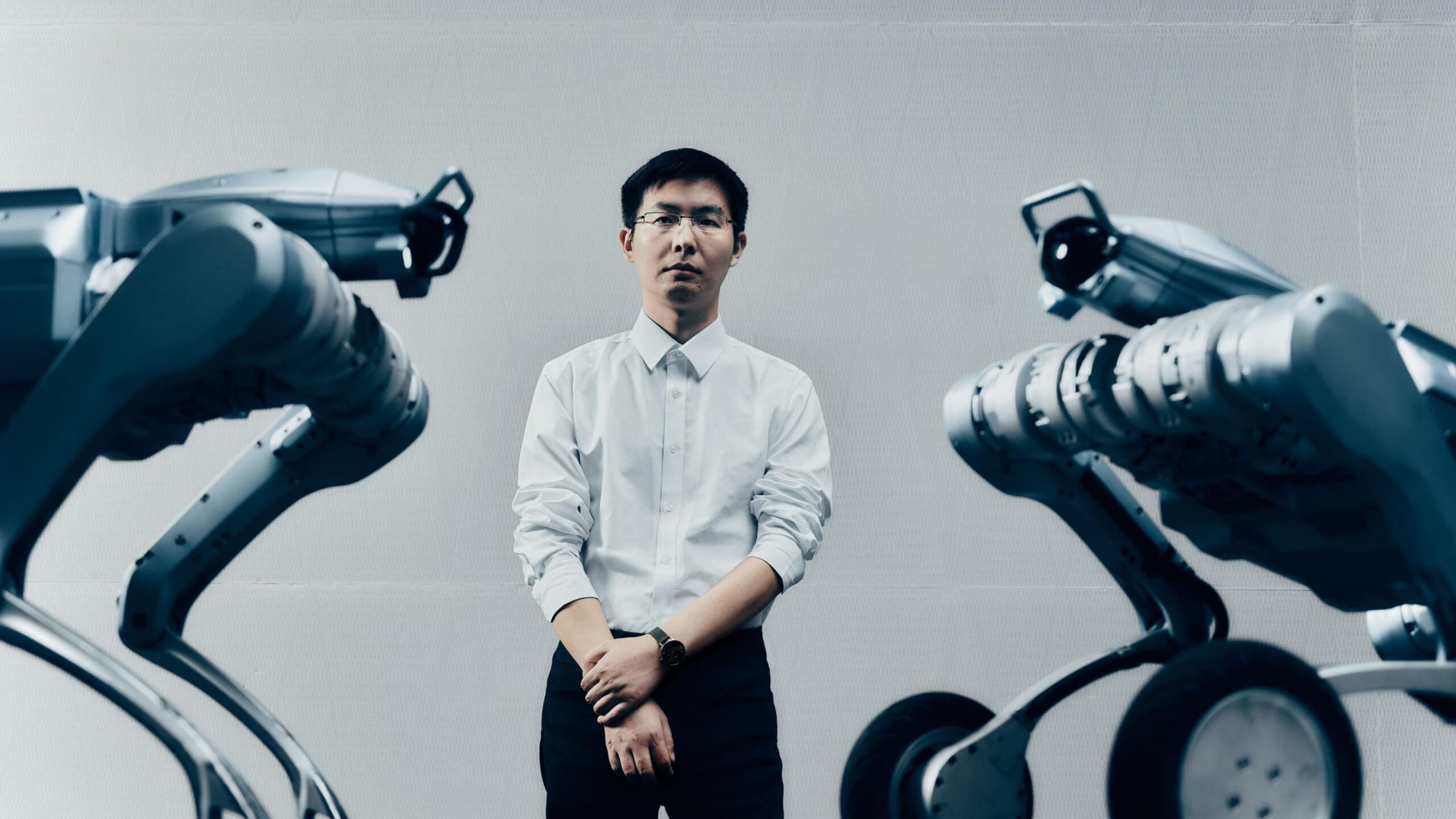
For now, Unitree is still wrestling with the same white whale as its legion of competitors: the generalization gap, which Wang calls “the biggest headache for the entire global scientific community.” While today’s back-flipping machines are engineering marvels, they remain stubbornly task-specific. If you want a robot to pick up a pen and move it across a desk, you must program every granular motion. But to make AI truly useful in the physical world, robots must transition from executing rigid scripts to understanding novel commands—like being told to simply “go to the grocery store.”
Achieving this milestone will require overcoming two self-reinforcing problems: the scarcity of 3D data and the diversity of deployment environments. Unlike LLMs like ChatGPT, which can parse the virtually boundless internet, robots need manipulation data collected in the real physical world, which is costly and difficult to scale. It must typically be collected manually by repetitively training machines how to perform certain tasks, such as folding shirts, stocking refrigerators, or shaking a mai tai. Plus, explains Jiang Zheyuan, CEO of Beijing-based humanoid firm Noetix, “even if a well-performing manipulation strategy is trained for a specific task, the success rate often drops sharply when the environment changes slightly—for example, object displacement, different lighting, or different tabletop materials.”
Read the full article here
