

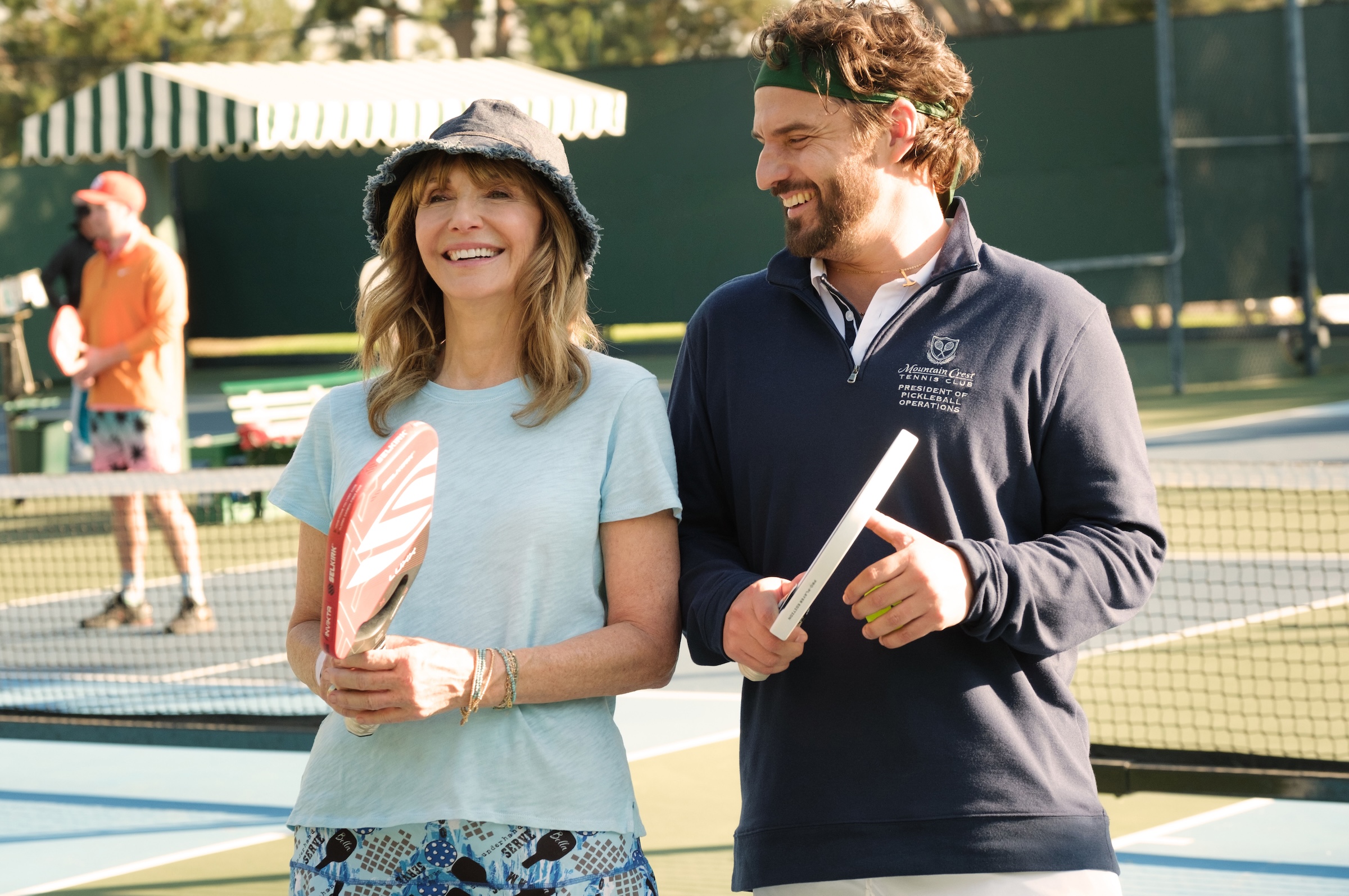
Pickleball, as you might have heard, has in recent years been considered the fastest-growing sport in America. So the combination of the sport’s name, how it’s played—on a tiny court, with a ping-pongish racket, and a wiffle-ish plastic ball—and surging popularity makes it ripe for parody.
Enter The Dink, a new comedy directed by Josh Greenbaum (Barb and Star Go to Vista Del Mar, Will & Harper), co-produced by Ben Stiller, and starring Mary Steenburgen, Ed Harris, and Jake Johnson. The film, which debuts on Apple TV on July 24, serves as a sweet ode to this burgeoning pastime, while still poking fun at its foibles. For example, the cast, which also includes Stiller, the late Lynne Marie Stewart, Aaron Chen, Chloe Fineman, and Cleo King, offers intentionally corny, and thus amusing, jokes about “the kitchen,” the pickleball zone in front of the net that participants absolutely cannot enter to hit volleys.
TIME caught up with Steenburgen, the Oscar winner and comedy stalwart—and real-life pickleball enthusiast—to talk about the sport, The Dink, and a humanitarian cause dear to her heart.
(This interview has been edited and condensed for length and clarity)
When and why did you start playing pickleball?
About two months before I knew anything about The Dink, my son Charlie McDowell gave me a paddle and said, “Mom, I’ve had women even older than you whip my ass.” I said, “That’s such a sweet thing to say.” He gave me some lessons. He’s been my encouragement. And I started taking lessons on Martha’s Vineyard by a woman named Connie McHugh, who’s an incredible coach and teacher, and she helped me to just fall in love with it. I saw in it something that I could do at this age that I could get good at–maybe not great at or world-class, but good at–and go have fun with friends, and feel like I had a sport, which I hadn’t had since my 40s, when I did start swimming competitively. I’ve missed having that feeling. So I started feeling that feeling again, of learning something with my body. I like puzzles a lot. Pickleball has a lot of puzzle aspects to it. Because it’s not just about power. It’s about finesse. It’s about angles. It’s about remembering all the little ways that you can trip yourself up. So I love what it does to how I think in my brain. And then I’ve made friends that I never would have known, people I never would have met, through this sport.
About two months into this happy journey, when I was about to close a deal on a different project, my agents and managers called and said, “Well, there’s one more offer for you, and we should probably tell you about it.” And I said, “What is it?” And they said, “Well, it shoots in L.A.” I go, “OK.” And they go, “It’s with Josh Greenbaum and Jake Johnson and Ben Stiller.” And I went, “You’re kidding.” So obviously it’s a comedy, and it’s a lead. And it’s about pickleball. I went, “That’s the one I’m gonna do.” “No, you have to read it first.” And I go, “I’ll read it, but that’s the one I’m gonna do.” It honestly felt like somebody in heaven just designed it for me.
Why do you think pickleball has gotten so popular in the last five, six years or so?
Because it’s sort of egalitarian. All ages can play. Any body type can play. You don’t have to be one of these extraordinary athletes. You can be a regular person and play at a level that will bring you pleasure and joy. And the hardest part is learning all the byzantine scoring and the rules and stuff. Also in my case, it was really finding people that were at a great level for me to play. That were hopefully a little bit better than me, so I would grow, but not so much better that they’d be bored playing with me. And I’ve found that now. So it’s really fun for me.
The movie plays on a real conflict that’s happened across the country: the fight over space. Pickleball’s expansion has required the need, for example, for the sport to take over tennis courts in some places, ruffling feathers. Full disclosure: I’ve felt this firsthand. I play tennis recreationally and basketball recreationally with my son, and pickleball’s encroached on our space a little bit. Do you have sympathy for us folks on the other side of this conflict?
Not really. [Laughs.] I don’t think we’re trying to do this for no reason. We’re trying to do this because of the best reason, which is it’s really fun. Do I want the sport of tennis, or God forbid, the sport of basketball to ever go away? No. Tennis is elegant. And basketball is, oh my God, a magical sport full of heart and brilliance. And there’s room for all of it. Do we all have to keep fighting over things when all of it is actually quite holy because it gives people something to do that’s good for them and brings them joy? In the case of basketball, it’s you and your son out there. I played pickleball with both my granddaughters last week and learned something about both of them. There is a holy thing to that. I don’t think we have to choose between things that are fun.
One of the film’s comedic bits is your character and Jake Johnson’s character playing against a team in which both players grunt loudly on the court. Are there really pickleball grunters?
I’ve heard it in pickleball. And it amuses me even more in pickleball than tennis because in tennis, legitimately it’s a long way from one side to the other. But with pickleball, it’s not that far. You don’t have to grunt.
Did you need a pickleball double for the film?
They had a double for me, and she’s since become a friend of mine. And she’s quite an extraordinary double because she was the No. 1 player in the world over 50. And her name is Beth Bellamy. Her son Roscoe is the No. 6 singles player in the world. My son and I have played with them. I played with Roscoe Bellamy, and he played with Beth Bellamy. And the funniest thing was watching the mother and son smash it at each other. I mean, so hard. And my son and I were looking at each other like, “I wouldn’t dare do that.” They’re high-level athletes. They’re amazing, and it was hilarious to watch them.
They used her in two-shots. It’s pretty much mostly me. I watch it and wish could do it all over again because I play better now than I did then. But that’s OK.
Do you play with your husband, Ted Danson?
I do not. He will not play with me. He has a bad shoulder. He doesn’t want to talk about it, and he won’t play with me. But I have plenty of people to play with.
So another line that stood out in the movie was, somebody said something along the lines of, “You can learn to play pickleball in an hour.” And then the response was, “As if that’s a good thing.” What’s your reply to that notion that pickleball is too easy?
Well, it’s not exclusive. And there’s a lot of exclusivity now, and not enough inclusivity. Anything that brings people together and makes them laugh is a good thing. And by the way, no one can learn the scoring thing and all the rules in an hour. It is so cockamamie and crazy. I’m still learning.
On a bittersweet note, Lynne Marie Stewart, who played Miss Yvonne on the groundbreaking Saturday-morning TV show Pee Wee’s Playhouse, plays one of your pickleball friends in the film. Stewart died of cancer in February 2025, a few months after filming wrapped. What was it like working with her?
I adored her. There was absolutely no sign of her being ill. I know she didn’t know, and then several weeks after the film, she became very ill. And the sweet thing I would tell you is that Jake and Josh took a rough cut of the film to hospice and showed it to her, as the last film she saw before she passed. She loved it and she saw how good she was in it. I think it was very meaningful for her that she got to do it and she got to see it.
You appeared in Elf, a stone-cold Christmas classic. And you actually ate the spaghetti and maple syrup concoction favored by Will Ferrell’s elfin character. What did that taste like?
Exactly what you think. I don’t recommend it. It’s not the worst thing I’ve ever eaten. Maple syrup makes everything better. But it’s not what your taste buds want out of spaghetti.
You also worked with Will Ferrell in Step Brothers. What stands out about that experience?
One thing is there was a phone call from Will Ferrell to me. I remember I was in my house on Martha’s Vineyard, and he called me himself out of the blue. We had done Elf the year before. I think it was the year before. And he said, “I know you played my stepmom in Elf. Would you be offended if I asked you to play my actual mom?” And I said, “Well, let me do the math here.” And I asked him when he was born. Then I go, “Well, Will, I would have had to have had you when I was 11. [Editor’s note: Steenburgen is 73. Ferrell is 59.] But the answer is, ‘I would be offended if you ask anybody else because I definitely want to do it.’” Because he and I had such a good time together on Elf.
But on the first day of Step Brothers, what he and John C. Reilly were doing was so high-level, off-the-charts, insane, bonkers, brilliant, that Richard Jenkins, who’s an extraordinary actor, and I looked at each other and went, “What the hell are we doing here?” And I think both of us had this kind of crazy feeling, like, “I can’t do that.” And so I went home that night, and I really thought about it, and I came back the next day, and I said, “Richard, I figured it out. I know what we’re doing here.” And he said, “What?” I said, “It is our job to hold down the truth that these two grown idiots are living at home with them. We have to make that real.”
At the 2025 Emmys, you and Ted received the Bob Hope Humanitarian Award. You’ve both been active in a variety of causes, including anti-apartheid in South Africa, research for pediatric AIDS, and the importance of arts in public schools. On the philanthropic/humanitarian front, is there anything new you’re working on that’s exciting or interesting or important to you?
There is. I once knew two doctors that I met through the White House Fellows Program many years ago, and they had a little boy named Sam. And when I met him, he was 3, and Sam looked about 95 because Sam had progeria, which is premature aging syndrome. I became friends with this little boy and remained friends with him throughout his all-too-short life. He lived to be a teenager and passed away some years ago. But his mother, who was a doctor, got herself put on the Human Genome Project, and she, along with Dr. Francis Collins, found the gene variant for progeria, which is amazing. Not only did they do that, but they, through the Progeria Research Foundation, have found a method of gene editing, and a little device that carries that into the organs of the body, that can go in mice and reedit genes to where someone with progeria today can actually get better. If it works with progeria, there’s a chance that all these rare and deeply underfunded diseases that more people should care about could actually be alleviated from the face of the earth. So I am trying to help them because they need to raise about $20 to $25 million to get this first patient to have this.
You’ve had such a long and varied career: you’ve won an Oscar and played all different types of roles in dramas and comedies. Is there any role you haven’t played that you still want to do? Any bucket-list items, career-wise?
I’ve never done Shakespeare. I’ve never done some of the great Southern kind of plays that I probably should have done. I balance what I do between my family and work and my marriage, but I also have a very important career to me that’s quite separate, which is I write music. I’m working on some things now that are really important to me. I don’t look at anything about my career with any disappointment. I look at all of it with gratitude. It’s crazy to me still that I get to do this. I constantly feel the need to prove myself and to get better. One of the things I love about it is that I don’t have a plan. I feel like what’s meant to be mine is going to come my way.
You mentioned music. You’ve talked about how, after minor arm surgery in 2007, you started hearing music in your mind all the time. What exactly happened there, where a medical procedure made you musical?
I had a surgery on my right arm that was very innocuous, except they did put me under for it. I’ll never know for sure, but we think they let my blood pressure get too low, and I had a little bit of a brain event. Not a serious thing. All I felt when I woke up was weird. So I assumed I’m just getting the anesthetic out of my body. But days later, I still felt weird, and you know, no one was helpful about what was going on with me. And Ted kept saying, “You seem like you can’t focus on what I’m saying.” And I said, “Well, I can’t focus because of the music.” And he’s like, “There’s no music playing.” I go, “Well, there’s music playing in here.” [Points to head.]
People say it was a gift. It might have been a gift, but it was a gift I had to work really hard to harness and make sense out of. My grandmother was extremely musical, so I don’t know if I just got to some part of my brain that was there that I hadn’t. I don’t know enough about the brain. But I became obsessed with music, and from the obsession, I started studying music. My first instrument was an accordion, which I just started playing. It didn’t take me long to figure it out. And then I consumed books about songwriting and started paying attention to song structure. All this work helped to calm it down to the point where I could behave like a normal person. But I am still absolutely obsessed with music, and particularly with writing music. I write mostly with people from or connected to Nashville, because I’m signed with Universal Music Publishing Group in Nashville, and I really love the Nashville way of writing and the seriousness about musicianship and writing. I just love my friends there. So we’re doing some crazy, wonderful things. We just got through writing two end-credit songs for movies. I enjoy it very much.
Very cool. Closing up on The Dink – what do you want people to take away from the film?
I hope they laugh in a summer where laughter is probably a really good thing. I hope some of them safely go out and have fun playing pickleball and don’t hurt themselves. I hope that it reminds people in the business that these smaller films that are beautifully written, with a great script, have value in the marketplace. And in a dream world, maybe we’ll get to do another one. That would make me very happy
Dink is a name for a pickleball drop shot. How’s your dink?
My dink is pretty good. I dinked against Anna Leigh Waters this morning, and although there were three of us playing one person, we did win best two out of three from my little dink.
And last question: Why the hell do they call it “the kitchen”?
I have no idea.
Read the full article here
